Don’t Be Too Nice

This post is adapted from a newsletter I wrote while on staff with Justice For All.

Estimated reading time: 4 minutes.

dontbetoonice

“Gracious confrontation” is not a contradiction in terms; it is an essential part of mastering the art of good dialogue. I learned this in April of 2014 at a Justice For All outreach after two conversations in one day showed me that sometimes mere “niceness” isn’t helpful.

My friend Holly and I were having a very polite and productive dialogue with a pro-choice student when I noticed another student named Jeff. He had been trying (unsuccessfully) to subtly eavesdrop on our conversation. When I invited Jeff to join the conversation and share his thoughts, the tone of the discussion immediately changed.  He very confidently espoused a worldview marked by moral relativism, and he denounced everything Holly and I had said as ridiculous.

Back in my high school days, I was rude and pushy in conversations about abortion, so in my first few years of full-time ministry, I erred too heavily on the side of being polite. As I asked Jeff questions and very politely tried to engage him, he continually cut me off and met my politeness with aggression.

I decided to try something different.
Why Rhonda Changed Her Mind About Whether to Use the Word “Pro-Choice”

Estimated reading time: 4 minutes.

We’ve been talking about language in the abortion debate a lot lately. It’s a subject I’ve written on several times before as well. If we want to be as persuasive as possible, it’s not only our arguments that matter, but the words we use that matter as well.

It’s not always easy for a pro-life person to go from using the label they’ve always preferred to a different one though. When we talk to people we form habits, and getting out of habits is always difficult.

I want to tell you the brief story of a woman named Rhonda who decided to change one of the labels she used to favor.

Avoiding an Embarrassingly Common Pro-Life Mistake

Don’t you hate it when your honest clarification question is mistaken for the start of a fallacious argument?

Estimated reading time: 6 minutes.

lincoln_title2

Almost every time in the last year I’ve talked with pro-choice students at a pro-life outreach, I’ve had an exchange that goes something like this:

Pro-Choice Student: The fetus isn’t even a person.

Tim: We agreed earlier that a newborn is a person. Do you think a fetus is a person right before birth?

Pro-Choice Student: *sigh* I know where you’re going with this, you’re going to try to trap me by asking if it’s a person right before that, or right before that.

Tim: No! I’m so glad you said that because that gives me the opportunity to clarify. The argument you’re describing is a logical fallacy, it’s one of the worst pro-life arguments I’ve ever heard, and if any pro-lifer out here makes that argument, I’ll prove them wrong on your behalf. I’m not trying to trap you, I’m just trying to figure out what your position is. What is it that makes us persons?

Unfortunately, because of how common this pro-life mistake is, the pro-choice student is expecting our conversation to go something like this:

Pro-Choice: The fetus isn’t a person.

Pro-Life: When do you think it becomes a person?

C: It isn’t a person until it can think.

L: So would you say it’s a person at birth?

C: Sure, it can think at birth.

L: Well, how about the day before it’s born?

C: I don’t know, maybe.

L: How about the day before that?

C: I think I see where this is going…

L: And how about the day before that? You just have to push back a little at a time to prove that there isn’t a difference between a newborn and a fetus. If the newborn is human, and there isn’t any big change in any day of its development, then it must have been human at the beginning.

C: Well I think there’s a big difference between the day it can think and the day before that.

L: Okay, then let’s talk about the day it can think. How about one second before that? The difference in the fetus from second to second is miniscule. So how can you say it is not human one second and human the next?

C: I don’t know how to explain it but I’m not persuaded.

When a Hypothetical Story Isn’t Hypothetical After All

Sometimes when I talk about abortion with strangers, it feels like I’ve already had that conversation before, because they’re making familiar statements. But the truth is, I haven’t had that conversation before, because I haven’t heard that statement from that person before. Even though some statements are very common, different people mean very different things by them. A recent conversation I had with a hotel shuttle driver named “Mark” reminded me that while I may have heard the same words before, I hadn’t heard his story before. I think there’s a lesson you can learn from this situation that will help you have better dialogues with pro-choice people.

Estimated reading time: 6 minutes.
Photo Credit: Prayitn via Compfight cc

Photo Credit: Prayitn via Compfight cc

I was in town to speak at a conference when Mark picked me up, and after we exchanged some pleasantries, he asked me what I do for a living.

From ‘I Don’t Want to Talk About Religion’ to ‘I Will Pray Tonight’

Estimated reading time: 6 minutes.

Sometimes when I have an opportunity to share my faith in Jesus, I don’t take it.

Stay with me.

Sadly, many people have had negative experiences with Christians, which makes them disinclined to engage with one again. If I jump at the first chance I have to witness to them, they are more likely to close up and be unwilling to talk at all.  Instead, I try to very intentionally create an environment where the person feels safe to discuss religion. [Tweet that!] It’s like the difference between welcoming someone to come inside and opening the door, and grabbing him by the hair and dragging him through it. Notice that I am not justifying Christians perpetually avoiding conversations about religion. We must be intentional about sharing our faith, but while also being prudent, making the most of the opportunity (Colossians 4:5-6). Sometimes the person never opens up, but other times, this approach really pays off.

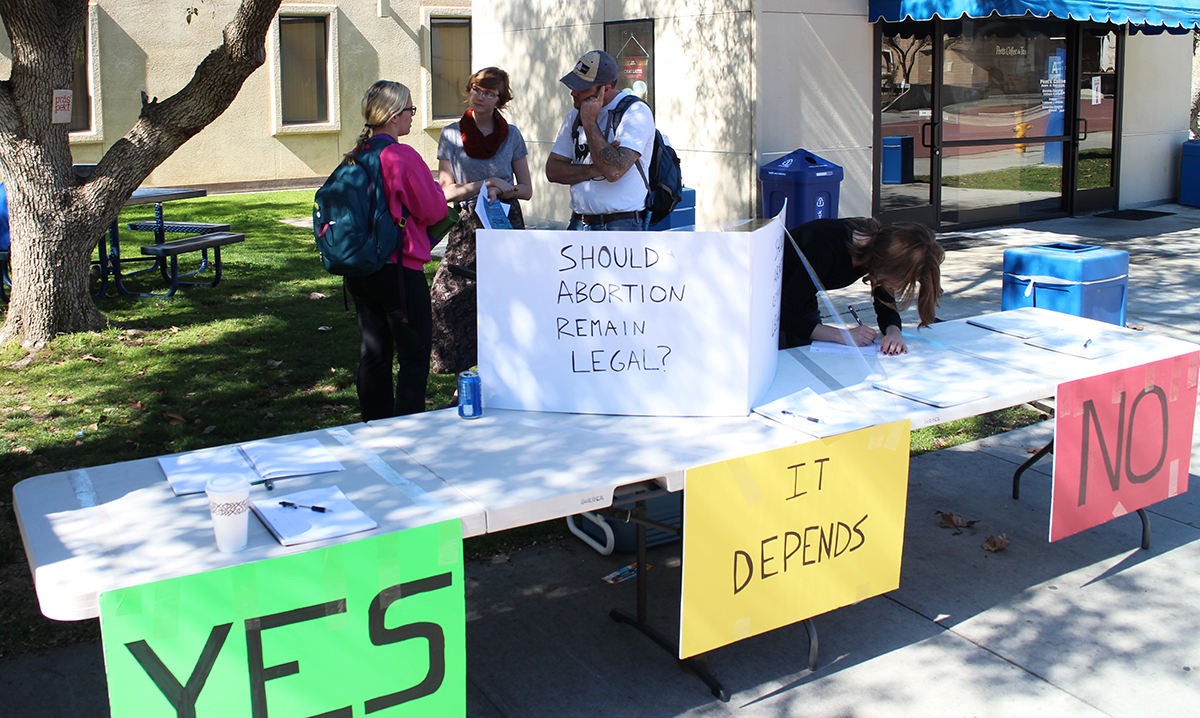
On February 21st, 2015, Equal Rights Institute trained a group of students and community members in Bakersfield, CA. Then on the 23rd and 24th we brought them to CSU Bakersfield so they could put what they learned about dialogue into practice. We set up two simple poll tables to get conversations started.

On February 21st, 2015, Equal Rights Institute trained a group of students and community members in Bakersfield, CA. Then on the 23rd and 24th we brought them to CSU Bakersfield so they could put what they learned about dialogue into practice. We set up two simple poll tables to get conversations started.