A trait that has always been essential to the core of ERI is being open-minded. But, what does that actually mean? Is there ever a time that we shouldn’t be open-minded? In this episode, Emily Geiger and Dr. Rebecca Carlson do a deep dive into the concept of open-mindedness, talk about what open-mindedness isn’t, and give some practical advice on how to avoid some common pitfalls when it comes to being open-minded.
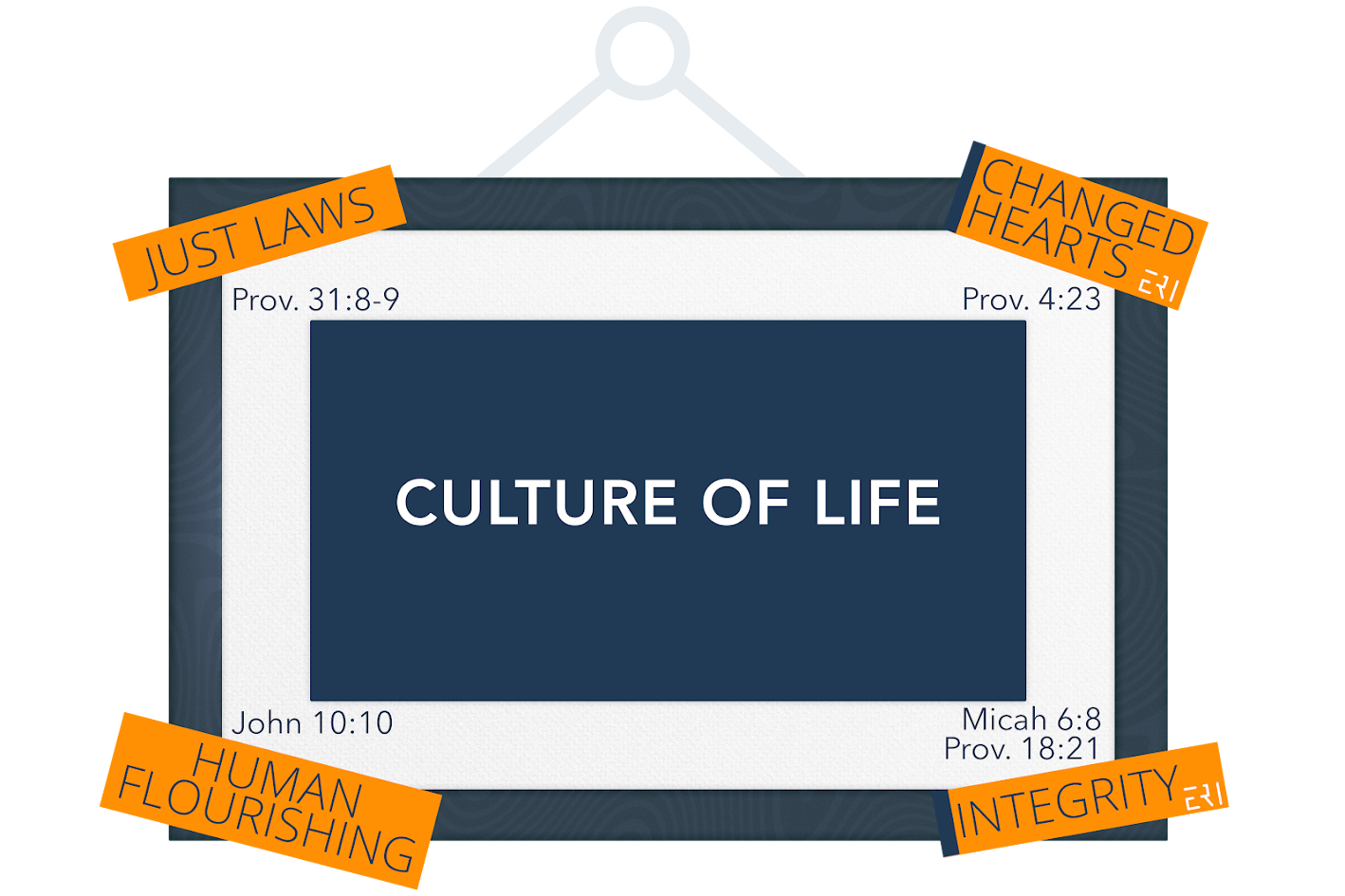
A frame has four corners. But after 50 years of ‘pro-life’ work, we’ve abandoned three corners of the frame—or, at best, let them deteriorate. Many are left clutching an important top corner, but the picture has become distorted, damaged, and is dangling in the wind. That remaining corner is important. At its best, it’s intelligently crafted pro-life policy. But there are three other corners to the frame. If we don’t reframe what it means to be pro-life in a more convictional way, our work is going to continue to be confusing, off-putting, and alienating to fresh generations. Generations that include our children and grandchildren, as well as a watching world.
That’s what I said when speaking at a church in central California recently. Let me explain what I mean.
For a lot of people, the term “pro-life” carries a lot of baggage. But I’d like you to imagine a picture that represents the best version of what a pro-life world could look like. Or, if you’d rather, replace “a pro-life world” with “a culture of life,” or “a life-affirming culture.”
Now that you have your preferred picture in mind, as well as your preferred phrase, I’d like us to think about the state of affairs in the pro-life movement using the analogy of a frame. Our most cherished pictures have frames to support and contain them. In the same way, to effectively champion a compelling vision of a culture of life, we need to support and contain that vision with a more expansive, consistent, and principled way of being pro-life. I’ll invite you to picture that way of being as a frame with four corners. Although I know not everyone reading is religious, because I’m a pastor as well as the President of ERI, in what follows, I’m going to give one or more Bible references in support of each corner of the frame. I also know that for many this will be an important way to illustrate and strengthen what I’m trying to say.
Let’s name the top-left corner of our frame Just Laws. It’s the one most closely tied to a politician’s stated beliefs (unfortunately, not always his or her true convictions). We might think of it as the legislative corner. Proverbs 31:8-9 says, “Speak up for those who cannot speak for themselves, for the rights of all who are destitute. Speak up and judge fairly; defend the rights of the poor and needy” (NIV). Just laws that protect unborn life are important, but there are also three other essential corners to the frame.
If the top-left corner of the frame is “Just Laws,” let’s call the top-right corner Changed Hearts. As many of us know well, courts and legislatures can make abortion illegal, but that’s a far cry from making it unthinkable in a particular culture. So if the first corner was the legislative corner, we’ll call this one the “unthinkable” corner.
We’ll formally announce this and say more about it soon, but I’m excited to share that ERI is updating our mission statement: “We equip everyday people to have smarter, kinder conversations that transform culture and save unborn lives.” The “transform culture” piece is directly related to the “changed hearts” or “unthinkable” corner of the frame. This corner reminds us of what internationally respected pro-life leader David Bereit said recently, and what history has shown repeatedly: “You only keep legislatively what you win upstream culturally.” Or, said differently, laws only stick when they reflect changes in the majority culture’s true thoughts and feelings.
In Bereit’s keynote, he went on to explain that “culture is not what a nation debates; culture is what a nation assumes.” For example, today we’re not having arguments about whether segregation is a human rights violation; most assume that it is. But that has not always been the case. Over time, our nation’s assumptions have changed, and our culture has been largely transformed in this area. Other examples of cultural transformation include movements like domestic violence reform, hospice and palliative care, tobacco denormalization, and civil rights. Unfortunately, when it comes to the unborn, we don’t have a broad, shared assumption that abortion is a human rights violation. That’s why it’s so important to commit more of our focus to the “unthinkable/changed hearts” corner of the frame. At ERI, we, along with many of you who partner with us, do this through developing and spreading “smarter, kinder conversations” that are laser-focused on transforming hearts and saving unborn lives. As Proverbs 4:23 says, “Guard your heart above all else, for it determines the course of your life” (NLT).
And this leads us to the bottom-right corner of the frame, which is not only essential, but also foundational in ways many have forgotten or given up on. Let’s call this the Integrity corner: by integrity, I mean both the character and the civility that go with our stated beliefs in the “legislative” corner. Or said differently, when we have integrity, our character (who we are) and civility (how we speak and act) will both be consistent with what we say and believe. In thinking about the first part of the integrity corner, character, let’s use Micah 6:8, the Bible’s simplest description of what a good human looks like: “He has shown you, O man, what is good. And what does the LORD require of you but to act justly, to love mercy, and to walk humbly with your God?” (BSB). In a person of character, justice is inseparably tied to humility and a love of mercy. For example, and to reiterate what I said to the California church, when pro-life legislation is connected to hypocrisy, corruption, and lies, this creates confusion and a disconnect in the eyes of our children and a watching world.
Civility, the second part of the integrity corner, means treating our fellow humans (including those we disagree with—even our enemies) with gentleness and respect (1 Peter 3:15). One of the most fundamental forms of respect that we can show to another person is to listen to them. Respect is very much a “life” issue, as is civility, for as the ancient wisdom in Proverbs 18:2 reminds us, “Death and life are in the power of the tongue” (KJV). Make no mistake: speech that dehumanizes anyone goes a long way to undermine the cause of humanizing and protecting precious unborn life.
The final, bottom-left corner of the frame we’ll call Human Flourishing. It encapsulates an expansive, holistic, and beautiful vision of life, capturing the sanctity of life from womb to the tomb and all the life-affirming opportunities in between. Jesus’ words in John 10:10 capture this vision well: “The thief comes only to steal and kill and destroy. I came that they may have life and have it abundantly” (ESV). Abundant Life is another way of expressing human flourishing. And this corner of the frame reminds us that pro-life work also includes consistently connecting the dots between abortion and other quality of life issues. Some traditions use the image of a “seamless garment” to capture this all-encompassing, expansive view of life from conception to natural death.
The “human flourishing” corner of the frame also offers a beautiful vision of life. English New Testament Scholar N.T. Wright notes that “beauty is both something that calls us out of ourselves and something that appeals to feelings deep within us.”1 Because of the “corner clutching” (e.g., only paying attention to the legislative/voting corner of the frame), fresh generations who care deeply about beauty are asking, “Is being pro-life an ugly form of humanity?” How will we answer them? How will we better connect the dots between abortion and other life-affirming issues? How will we reframe what it means to be pro-life in a more expansive, consistent, and principled way?
Let me close with a personal example that reminded me recently of this expansive womb-to-tomb beauty. Toward the end of 2025, I suffered a serious injury that set our family back financially because I was not able to work. As we raised a glass on New Year’s Eve, I thought to myself, “Boy, I sure hope 2026 brings some fresh hope and surprises!” Then in January, I celebrated my 60th birthday. Following this milestone, I saw the picture below where I’m surrounded by all eight of my grandchildren, and it reminded me—in the midst of all of life’s struggles—of just how rich I was. And then it hit me, related to our issue of changing hearts and minds about abortion: we need these experiences of beauty and goodness to be able to combat the ugliness of abortion without getting lost in it. We can hate and fight against abortion, but we also need to be fighting for something—both for our own sake and for the sake of casting a compelling vision for others.
Simple glimpses like these of loving relationships and generational support are the kind of beauty that is part of human flourishing and a reframed culture of life—the kind we need to recapture, celebrate, and cherish for ourselves, our children, and our communities as part of what it means to be pro-life.
So we ask you to pray, continue to partner, and send us feedback as we “equip everyday people to have smarter, kinder conversations that transform culture and save unborn lives”—and as we champion reframing the life issue for a new day.
Yes, attending to and clutching only one corner of the frame is easier. But we know the results well: short-term wins and fragile legislation that can be changed with one stroke of the pen.
This kind of “corner clutching” is a form of doing the same thing over and over and expecting a different result—which is Einstein’s definition of insanity. We can recommit, however, to reframing what it means to be pro-life in a more principled way—attending to all four corners: just laws, changed hearts, integrity, and human flourishing. Admittedly, it’s a much harder path and a long-term investment, but it’s one that promises a much clearer picture of all that it means to be pro-life and a compelling vision that celebrates all that is good, beautiful, real, and true.
Will you join us? If so, subscribe here, and if you have already, please consider sharing this article with a friend.
N.T. Wright, Simply Christian (New York:Harper Collins, 2006), 44. ↩︎
In this installment of the Equipped for Life Podcast, Emily Geiger and Dr. Rebecca Carlson dive deeper into what it means to express compassion in conversation, particularly when discussing difficult topics like abortion, rape, and poverty.
Note: Although this episode does not describe rape or sexual abuse in detail, it does make reference to survivors and resources related to addressing sexual abuse.
Chapters:
00:11 Intro 02:50 How do you “get compassion”?
06:20 How do I prepare myself for hard conversations?
15:02 How do I learn about and work through hard circumstances?
27:07 Practical tips for expressing compassion well
What do you do when pro-choice talking points feel so stupid or so evil that you don’t even know what to say? I talked in my last blog post about what to do when something is so far beyond the pale that even most pro-choice people would agree with you about it—like if someone actually straight up says it should be legal to kill toddlers to reduce overpopulation. Often if a pro-choice person says something like that, it’s because they feel trapped. So I talked about some strategies for helping them feel safe enough in the conversation to edit what they said if it’s not really what they think.
But there are some things that feel obviously crazy to a lot of pro-life people that don’t feel crazy to a lot of pro-choice people. If the pro-choice person you’re talking with says one of those things, it’s probably not because they feel trapped, but just because it just genuinely doesn’t feel obvious to them the way it does to you.
For example, let’s take a close look at “I know it’s a human being, I just don’t care.” Not every pro-choice person would agree with that (and many wouldn’t put it quite that starkly), but a lot of pro-choice people agree that a fetus is a living human organism, and some will even grant at least for the sake of argument that fetuses are people with equal rights, and they still think abortion should be legal. What’s happening when a pro-choice person says that?
Step 1: Clarify
Step 1 is the same whether you’re dealing with something that feels crazy to most pro-choice people or something that just feels crazy to you—and sometimes it can even help you figure out which of those two buckets you’re dealing with.
If you have lots of dialogue experience and training and you have some guesses about what they might mean, offering multiple plausible, smart options for what they could be saying is a great way to go. It will help reassure them that you’re not trying to straw man them—you genuinely want to understand the smartest version of what they think. But if in the moment you’re genuinely just flabbergasted, you can only think of one thing they might mean, and it sounds genuinely crazy to you, it also works to say something like:
“Do you have more words you can put around that? I want to understand your view accurately, and I’m guessing that the way I’m interpreting that isn’t what you actually mean. What I’m hearing you say is that you know abortion is a horrific human rights violation—that it unjustly kills an innocent person—and you don’t care. But I’m guessing that’s not what you actually mean—can you help me understand you better?”
As you do this, try not to come across as shocked. Fairly or not, pro-life people have a reputation for being sheltered and pearl-clutching. (Think every homeschool stereotype you’ve ever heard.) One really good goal to have in mind as you dialogue is to disrupt the caricature of pro-lifers that the person you’re talking with has in the back of their head. I don’t mean you shouldn’t be deeply grieved by abortion. And once you’ve built up enough rapport in a conversation, it can sometimes be helpful to be transparent about your grief with a pro-choice person. But get to the point where you know enough about what kinds of things pro-choice people tend to think and say that you’re not shocked when you hear them.
Step 2: Have a Map
As you get more dialogue experience and training, one super helpful thing you’ll get more and more able to contribute to the conversation is actually the smartest pro-choice arguments. That may sound counterintuitive—why would you want to make smarter pro-choice arguments? Doesn’t that lose you debate points or something?
But one thing that happens a lot in abortion conversations, especially with pro-choice people who haven’t thought deeply about their view, is that they say something fuzzy and inarticulate but know that there’s a smart, articulate thought there that they’re reaching for. Often a pro-life person who knows a little bit more about abortion arguments can easily dunk on the fuzzy thing the pro-choice person just said, but that very rarely changes the pro-choice person’s mind (even if you dunk on it gently and kindly). And it actually shouldn’t change their mind—it’s not because they’re being obstinate and closeminded, it’s because on some level they know there’s a smart argument they were trying to express, and you haven’t answered that smart argument yet. If you can help them get to the smartest version of the argument they’re trying to make, then you have a chance to actually answer it, and a much better shot at helping them change their mind.
It’s like having a map of the abortion dialogue in your head. If someone is trying to talk to you about a city and they say “It’s that one with all the movies,” you could make them feel stupid for saying something vague and inarticulate, but that won’t get you very far. Or, you could helpfully say, “Oh, are you thinking of Los Angeles, or maybe Hollywood?” If you can help a pro-choice person get from the fuzzy thing they actually said to the articulate thing they were trying to think of, you’ll be able to have a much more productive conversation.
Step 3: Learn How to Argue for the Obvious
The final skill you need to be able to respond effectively is arguing for the obvious. (For the specific example of arguing that it matters that fetuses are human beings, one really great tool is the Equal Rights Argument.) Usually, if something feels so obvious to you that you don’t even know how to make an argument for it, that’s actually a gap in your own understanding of your view. If you can fill that gap, you’ll be able to meet pro-choice people where they are in a way that can actually help them understand where you’re coming from, and ultimately change more minds and save more lives.
Imagine that you wake up tomorrow in a hospital bed. You have no idea how you got there. Scary, right? You look around and see that there is a tube coming out of your side and going into the side of a mysterious person lying in the bed next to you.
Suddenly, the doctor comes running in and says, “You’re finally awake! I’m so sorry, let me explain what’s going on. The man in the bed next to you is a world famous violinist with a rare kidney disease that requires him to be hooked up to someone else’s kidney for nine months. You were kidnapped by the Society of Music Lovers, who figured out somehow that you’re a kidney match. These superfans kidnapped you and hooked you up, and then left you here so you can be hooked up to him for nine months. This is incredibly unjust and I’m so sorry! But here’s the problem: now you’re kind of stuck. If you disconnect from him, he will immediately die. And he’s a person, with the same equal right to life as you!”
Even though the violinist will literally die if you disconnect, most people would agree that you still have the legal right to do so. Maybe you’re a worse person if you choose to unplug, but almost everyone believes that the government just shouldn’t force people to donate their time and bodily resources to other people. That seems pretty obviously wrong.
Let me connect that to pregnancy for you. This pro-choice argument says that even if human fetuses are people, even if they have the same equal right to life as everybody else, even though they are literally going to die if a pregnant woman refuses…the government just shouldn’t force a woman to donate her body to an unborn person. We don’t force organ donation, so we certainly shouldn’t force pregnancy. Women have a right to refuse the use of their bodies by other people, period.
This Right to Refuse argument originated with Judith Jarvis Thomson in her paper, “A Defense of Abortion.” She wrote that analogy about you being kidnapped and connected to a violinist who needs your kidneys to survive, and now this argument makes the rounds of the abortion conversation all the time. People will simply refer to it as “the violinist” or they’ll bring up the same concepts by talking about blood donation or not forcing people to donate their organs.
Check your reaction…
When I first introduce pro-life people to the Violinist argument, I usually see one of two reactions: panic or eye-rolling.
Let me address the eye-rolling first. They’ll say something like “Pregnancy is nothing like organ donation! Pregnancy is a gift! It’s beautiful!”
Now, as a woman currently 33 weeks pregnant, I don’t disagree that pregnancy is a wonderful gift. But pregnancy is also a lot like organ donation.
There is quite literally another human using my organs—in this case temporarily—because their organs aren’t at this time capable of functioning as they’d need to to sustain separate living. A zygote, embryo, or fetus requires constant use of her mother’s organs, blood supply, and nutrients. In many ways, pregnancy is weirder than normal organ donation. Normal organ donation is a one-time major medical event with side effects and recovery time. But in pregnancy, I’m literally feeling the human who is using my organs for many, many months, and likely feeling very sick for several of those months—and then I still have to go through a major medical event with side effects and recovery time.
I was bedridden for 10 weeks at the beginning of my pregnancy. And as I type this, my tiny human has apparently decided to run a marathon. Not gonna lie, it’s more than a little distracting to be repeatedly kicked in your ribcage.
Pregnancy is a lot like organ donation.And the violinist is a lot like the tiny human inside me. The whole point of the violinist analogy is to argue that even if pro-lifers are right and a fetus is morally equivalent to an adult, you still have the right to an abortion because you have the right to refuse to donate your organs to other people. Judith Jarvis Thomson is assuming, at least for the sake of argument, that fetuses are people. And that’s where the panic comes in.
I panicked the first time I heard the violinist analogy my freshman year of college. I was literally stumped. Up until that conversation, I had assumed everyone was pro-choice because they didn’t understand biology, or because they thought what gave humans value was some trait they acquired later on in development. I had never heard of a pro-choice argument that granted that fetuses are equal in value to you and me. And I had no idea how to answer it.
I seriously questioned whether I had an obligation to become pro-choice now—since I couldn’t explain why a pregnant woman shouldn’t be able to refuse to donate her organs to an unborn person but should be able to refuse to donate her organs to a born person. After all, my right to bodily autonomy is incredibly important! It’s why I have to sign 7,000 consent forms every time I’m at the doctor’s office. It’s one of the reasons that sexual assault is so deeply wrong and harmful. Everyone’s bodily autonomy is extremely important and deserves to be respected. So shouldn’t pregnant women have the same bodily autonomy everyone else has?
Now, panic isn’t the reaction I want my audience to have when I first explain the violinist argument, but I do want you to stand, just for a moment, in healthy awe of how smart it is. Of just how well it appeals to what we already believe about the realities of pregnancy, the personhood of the unborn, and the importance of bodily autonomy. It shouldn’t be shocking why this argument is so persuasive to so many college freshmen reading Thomson’s paper in Philosophy 101, or why my TikTok feed is full of pro-choice people bringing up organ donation. It’s not an argument to roll your eyes at.
But no, we don’t all have an obligation to become pro-choice either.
You see, the question isn’t “Is pregnancy analogous to donating an organ?” Because I think the answer is, in many ways, yes. The question is “Is abortion analogous to refusing to donate an organ?”
That’s where the violinist argument breaks down.
After you’ve recovered from that initial reaction…
…you’re probably shifting into the “responding phase.” And the gut response I usually hear from pro-lifers is something about an obligation to help.
“The violinist is a stranger, but the fetus is your own child! You have an obligation to help your own child.”
“Your kidney was designed for you, but your uterus was designed for a baby. You have an obligation to let them use the thing that was designed for them.”
“In the Violinist story, you were kidnapped! This whole situation isn’t your fault! But in 99% of pregnancies…you are the reason the fetus is in this situation. This isn’t some big surprise. You willingly engaged in an action which you knew might result in the creation of an inherently needy child, so you have an obligation to help them.”
The third response above—often called the Responsibility Objection—is a solid argument, and we’ve taught it here at ERI before. The problem is, our team just doesn’t find it that persuasive to the vast majority of pro-choice people. And the first two responses? I actually think they’re bad arguments; they don’t work when you follow them through to their natural conclusions.
Convincing you of that isn’t my purpose today though. Even if I thought that all three of them were solid responses to the violinist, I still wouldn’t use them.
I don’t want to spend my time arguing about when we have an obligation to help other people; in today’s society, that’s honestly just a hard sell. I’m dramatically more persuasive when I spend my time arguing for the modest claim that we have an obligation to not literally kill people.
The Obligation to Not Kill
When you find yourself plugged into that violinist, you hypothetically have three options. You could help the violinist by staying hooked up for nine months, which would be super nice and arguably the right thing to do, but I don’t think that should be legally required of you. You could choose to not help the violinist, which would be you refusing to stay plugged in to the violinist for nine months.
Or, hypothetically, you could kill the violinist. After all, if they are dead, they definitely don’t need your help anymore! You could just shoot the violinist, right now, and they’d be dead. Problem solved. It would save you the embarrassment of saying no to them!
So three options: help, not help, or kill the violinist. But we all know that you shouldn’t do the killing one. In situations where you have all three options, helping and not helping should both be legal, and killing should be illegal.
Here’s the problem though: you don’t always have all three of those options.
Let’s imagine another story: what if I get super rich and buy a yacht. Huge boat, all the fun stuff on it you can imagine, GIANT yacht. So, obviously, I’m going to take my amazing yacht out into the ocean. I’m hours from shore in shark-infested waters when I discover that there is a preschooler on my boat.
This little girl was playing hide-and-seek on the docks with her siblings, she found a fantastic hiding spot in the closet on my yacht, and she fell asleep waiting for her siblings to find her. Now that I’ve found her hours later in shark-infested waters, I am kind of stuck. I really only have two options! One, I can help the preschooler by sheltering her peacefully on my boat until I take the boat back to shore and hand the girl over to the police or her parents, and after that I don’t think I should have to do anything else to help her.
Or…hypothetically, I could kill her. I could say, “This is my boat, and I have the right to refuse the use of my boat to this tiny person who is trying to use it” and then toss the preschooler overboard.
Those are my only two options: help or kill. The only way to stop helping her with my boat would be to throw her overboard, which wouldn’t just be not helping—it would be killing her. So there is no way to just not help—it doesn’t exist! If there was a way to Star Trek beam the preschooler off the boat and onto shore next to her parents so I wouldn’t have to deal with her anymore, that might be a “not help option,” but we all know that doesn’t exist. So if help and kill are my only options, and I think killing is always wrong except in cases like self-defense, then I think I’m obligated to help.
I’m not interested in forcing people to help other people in general, but I am going to put my foot down and say that you don’t get to kill other people. So I can’t throw the preschooler overboard. When the only way to avoid helping is to kill, I legally have to help—not because I generally have an obligation to help people, but because I have an obligation to not kill people.
(Note: While our team uses The Obligation to Not Kill and the killing versus letting die distinction in the majority of our conversations with everyday pro-choice people, it can be helpful for some more philosophically-minded people to pivot to the distinction between making someone better off, worse off, or keeping them in their original state. You can find our more advanced article on that here.)
Of course, giving a preschooler a boat ride is not comparable to the demands of pregnancy. I’m pregnant; I very much understand that. In no way do I want to diminish what a pregnant woman goes through. But there’s one important similarity between the two cases: in both, there is no way to just “not help.” There’s no way to “unplug” from the fetus to stop being pregnant.
In pregnancy, the woman only has two options. She can help the fetus by allowing him or her to exist in her womb for nine months and giving birth, at which point she doesn’t have to have any further legal obligation to the child. Or she can kill the child by having an abortion.
There is no “just don’t help” option. If we could Star Trek beam the fetus out of the mother’s womb into an artificial womb where she wouldn’t be pregnant anymore and the fetus would live, that would be a way to just not help. But we don’t have that technology, so there is no “I just refuse to help you” option. Since help and kill are a pregnant woman’s only options, killing via abortion should still be illegal.
I wouldn’t normally ask someone to tolerate a strange preschooler on their boat. I’ll ask for it only for as long as it takes to get them to shore safely, because there’s no other non-violent option. I wouldn’t normally ask someone to tolerate a prenatal human in their body (and the physical symptoms that come with it!). I’ll ask for it only for as long as it takes to get them to a place where they can live without your help, because there’s no other non-violent option.
You absolutely have a right to your bodily autonomy, and to refuse the use of your body to someone trying to use it. But those rights have a limit. None of us have the right to kill innocent people, period. And elective abortion always involves lethal violence targeted at the unborn human.
For examples of how we use this analogy in conversation with pro-choice people and responses to common objections, check out our comprehensive course.