Four Practical Dialogue Tips from My Conversation with Brent

Estimated reading time: 12 minutes.

I noticed John Paul, one of our volunteers, looked nervous in his conversation with a student in front of our poll table. I walked up and started listening so he could get help if he needed it. John Paul quickly asked me for my take, and I started asking questions to try to figure out what the other student’s view was. “Brent” had signed “Yes” to the question “Should 20-Week Abortions Remain Legal?” I asked:

Tim: Why do you think 20-week abortions should be legal?

Brent: It’s a woman’s right to live her life the way she wants to.

Tim: Do you think there should be any restrictions on abortion at all? What do you think of, say, a 35-week abortion?

Brent: Oh I’m definitely opposed to 35-week abortions.

Tim: You are? Aren’t you restricting women’s rights to live their lives the way they want to?

Practical Dialogue Tip #1: Turn the Tables on Pro-Choice Rhetoric


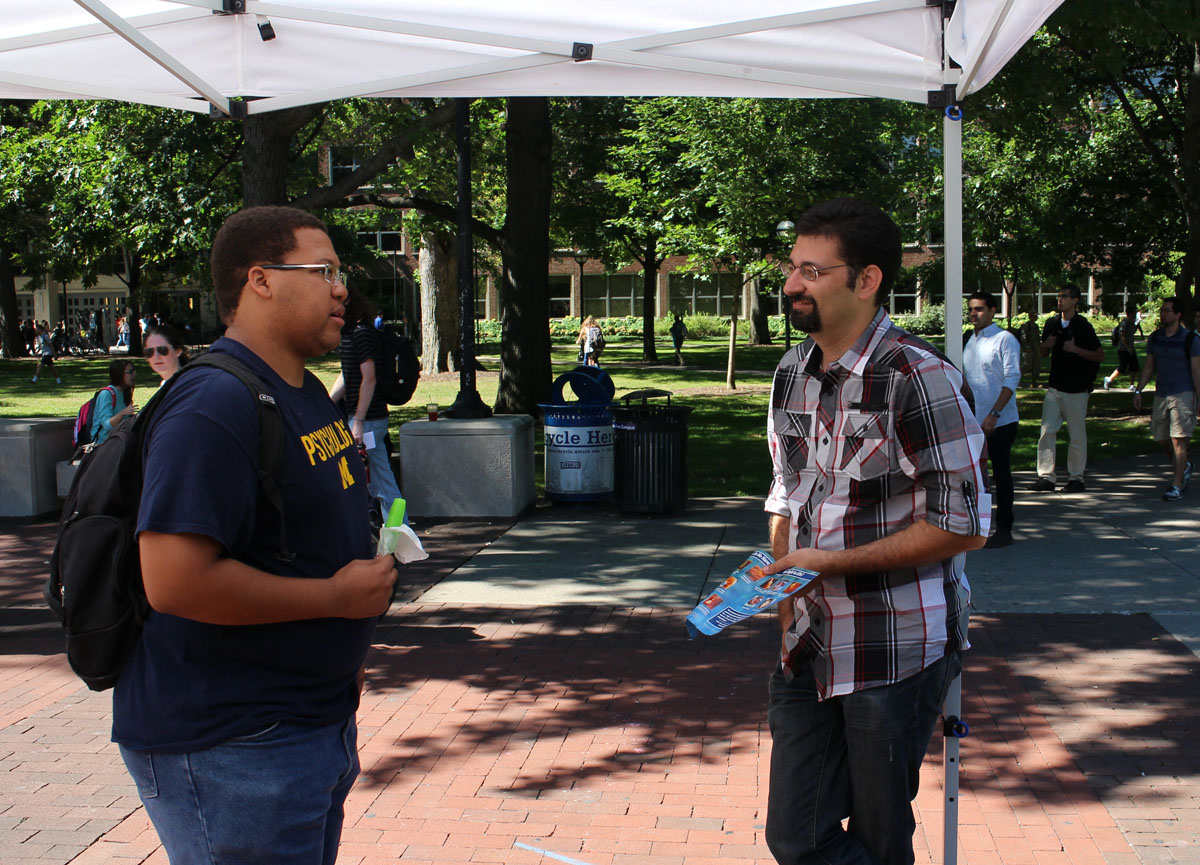
Picture: Tim's conversation with Brent where these dialogue tips came from.

A great deal of pro-choice rhetoric uses the kind of language that does not very naturally allow room for any restrictions on abortion. For example, any bodily rights rhetoric is going to suffer from this problem. For instance, you can’t say “my body, my choice” to only justify early abortions, because late-term fetuses are still located in her body. In order to justify early abortion without justifying late abortion, you need to argue that the late-term fetus is more valuable than the early-term fetus.

When I notice these kinds of rhetorical mistakes, I will frequently “turn the tables” on them in a gracious way. This is often an extremely weird experience for the pro-choice person because they’re used to the rhetorical power of “my body, my choice” working in their favor, and all of a sudden they find themselves having to argue against it. This tactic would work very well in debates, but that isn’t how I use it. Rather than merely trying to score rhetorical points, I’m hoping to accomplish two things:

  1. I want to help the pro-choice person learn to think more clearly about their rhetoric. It often is not nearly as powerful as they feel like it is, and making them answer the same rhetoric can help them to understand this.
  2. I want to force them to clarify their position. Dialogues only improve when arguments become more clear, and encountering this kind of inconsistency in their position forces people to either shift to an argument with more substance or clarify why they think their rhetoric doesn’t work against their own view.

Brent: No, because before 20 weeks, the fetus isn’t viable.

Tim: You’re right about that. I’m trying to understand your view so help me out here. Why do you think viability is important?

Recognizing the Root Problem

recognizing-the-root-problem---no-text

Estimated reading time: 4 minutes.

A few weeks ago I wrote about the importance of pro-life advocates being open to letting their conversation change topics. I gave the examples of religion and same-sex marriage and described how it might be more important for a given person to talk about one of those issues than to talk about abortion. Good dialogue requires the ability to listen well to the other person, as opposed to stubbornly sticking to your flowchart. [Tweet that!]

There’s another common reason that I change topics from abortion to something else: I discover that there is something more seriously wrong with their view than that they are pro-choice about abortion. Sometimes you can’t realistically make progress on abortion unless you deal with something else first.

Moral Relativism

Probably the most obvious example of a time to stop talking about abortion is if the person you’re talking to is not only pro-choice, they’re a moral relativist. If a person doesn’t think any action is morally wrong, even an obvious case like rape or child abuse, convincing them of the wrongness of killing a fetus is pretty hopeless. People tend to relate much better to victims of child abuse and survivors of rape much better than they relate to human fetuses. In order to consider defending fetuses they don’t emotionally connect to, they need to at least be able to see something like rape as evil.

My Conversation with “Mark” on Personhood and Apathy

Estimated reading time: 2 minutes.

This is the story of one of the dialogues I had during our outreach at the University of Michigan.


IMG_0240

I talked to a student I’ll call “Mark” at the University of Michigan who was pro-choice. He thought personhood began in the 2nd trimester, but he wasn’t sure why. I told him my concern was that I wanted an explanation of personhood that would make sense of the idea that all human adults should have an equal right to life. I’ve never seen someone understand where that logic leads so fast. He immediately said, “Oh, if we’re trying to give everyone an equal right to life than personhood would start here” and he pointed to the fertilization picture.

Be Open to Letting the Conversation Change Topics

Estimated reading time: 4 minutes.

Learning to defend your deeply held beliefs is really important, but it’s easy to get into the wrong mindset. Sometimes we get so focused on supporting the arguments for our view and defeating the arguments for the other view that we get…well, weird. We can get into the kind of focus where we are so oblivious to the person in front of us, we might as well be arguing with a robot.

Apologetics is not an end in itself, it’s a means to an end. The end for which we use apologetics is loving people by seeking their best interest.[Tweet that!] Sometimes that means our dutifully studied arguments become unnecessary.

One of the traps that comes along with the territory of studying apologetics is getting into a “flow-chart mindset.” If she says A, you say X, if she says B, you say Y, and so on.

dialogue-flowchart

But the times I go on autopilot and I’m thinking too much about the argument, I lose track of the person, and often the point. This is why it’s important to respond to people, not merely their statements.

And this is why I’ve learned to let the conversation turn away from abortion.

Sometimes.

A Simple Change That Instantly Communicates a Nuanced Approach to the Abortion Debate

It was only two months after launching Equal Rights Institute last year before we facilitated our first outreach. We had our training seminar developed by then, but we hadn’t yet had the opportunity to design our own outreach tools. So we utilized our favorite poll table option that we learned during our work with one of our favorite pro-life organizations, Justice For All. The sign on the table asks “Should Abortion Remain Legal?” This sign always stops a good number of people who see it, giving us a chance to engage them in productive dialogue.

Estimated reading time: 7 minutes.
On September 26th, 2014, Equal Rights Institute trained a group of Biola University students. Then on September 30th we brought them to CSU Fullerton so they could put what they learned about dialogues about abortion into practice. We set up the "Should Abortion Remain Legal" poll table the way we have for years.

On September 26th, 2014, Equal Rights Institute trained a group of Biola University students. Then on September 30th we brought them to CSU Fullerton so they could put what they learned about dialogues about abortion into practice. We set up the “Should Abortion Remain Legal” poll table the way we have for years.


This spring my friend Dr. Charles Camosy reached out to me to ask me to preview his upcoming book,
Beyond the Abortion Wars. It has now come out, and I would highly recommend reading it. We don’t always agree with his conclusions, but even the places where we disagree are well-researched, well-argued, and well-explained, and they help me to think more clearly about my own beliefs. Charles Camosy is a very unusual, very interesting voice in the pro-life movement and any pro-life advocate would benefit from wrestling with him.

While reading it I came across this section. These are excerpts from pages 26-29: (emphasis mine)