When They Bite the Bullet

Download Audio MP3 | 01:14:53

Josh and Rachel respond to the common question of what to do when the person you’re talking to “bites a bullet,” by saying something like, “Maybe we can kill toddlers sometimes,” or “maybe squirrels are persons.” They also briefly discuss how to respond to utilitarians and moral relativists, who often bite bullets.

Related Links:

Subscribe to the Equipped for Life Podcast on Apple Podcasts or Spotify. Subscribe to ERI’s other podcast on Apple Podcasts or Spotify.

Why Even Thomson’s Violinist Condemns Planned Parenthood’s Selling Baby Parts

The silence from pro-choice people in response to the recent Planned Parenthood videos is deafening. In this post I explain why they should be furious with Planned Parenthood too.

Estimated reading time: 14 minutes.
planned-parenthood-violinist-title

My dad Rich is currently receiving treatment for a type of cancer called Mantle Cell Lymphoma, so he needed to put together an advance directive for his health care. Much of the language for his particular advance directive comes from the language National Right to Life includes in their recommended “Will to Live” forms. He named my mom Lisa as his “Health Care Agent,” the person responsible for making decisions in the event that he is incapacitated in some way. If my mom also became incapacitated, that significant responsibility would then fall to Josh, and then to me. Naturally, we carefully read his advance directive and had conversations with him so we could better understand his wishes. (If you believe in God, please keep him in your prayers.)

dad

My parents, Rich and Lisa Brahm

The reason I mention this is that there was a requirement in the advance directive that stood out. In order for it to be legally valid, he had to sign it in the presence of two witnesses, and there are very specific guidelines for who those witnesses can be. In addition to needing to be of sound mind and at least 18 years old, a witness,

– Cannot be a person who was selected to be your health care agent or back-up health care agent;

– Cannot be a person who will knowingly inherit anything from you or otherwise knowingly gain a financial benefit from your death; or

– Cannot be a person who is directly involved in your health care.

This is a great rule, because it helps to protect the patient from others making decisions about his health care out of their own self-interest. Even though my dad named his wife as his health care agent and she could financially gain from his demise, he is not allowed to name her without the approval of two objective witnesses that do not gain.

While there is no way to perfectly protect the patient, I really appreciate this rule because it implicitly acknowledges the dangerous conflict of interest that can exist between a patient and his family. I want that danger to be acknowledged because I want my dad to be treated as an end, not merely as a means to an end. I want all human beings to be treated as ends, not as means to ends. [Tweet that]

That doesn’t mean humans can’t ever be useful to each other. It’s okay to ask your friend to be useful by helping you move; it’s not okay to treat him disrespectfully when he helps you. Treating humans as ends means treating them like they’re valuable in and of themselves, not based on what you can get out of them.

There is a very stark contrast between how careful we are to make sure a cancer patient is treated as an end and how Planned Parenthood treats the unborn.

There are two ways to justify the practice of abortion. The pro-choice person must either 1) Deny the personhood of the unborn, or 2) Argue that abortion is justified killing of human persons on the grounds of bodily autonomy, that a woman’s right to her body trumps the right to live of a human person inside her body. I have come to believe that one of the most common causes of confusion for pro-life advocates is a lack of understanding of bodily rights arguments, which are incredibly common and are the basis of much pro-choice rhetoric (for instance, “my body, my choice”).

I think the only way to defend Planned Parenthood’s selling of fetal organs is to deny that an unborn human in the second trimester is a moral subject, a person, someone who deserves to be treated as an end. In other words, they have to take the first of the two paths I described above; they cannot defend Planned Parenthood via the second path. But many pro-choice people are only comfortable with second trimester abortions because of bodily rights arguments (after all, the later in pregnancy it gets, the harder it gets to deny the personhood of the unborn). It seems like those pro-choice people ought to be coming out in droves condemning Planned Parenthood for selling baby parts, and it’s very puzzling to me that they aren’t.

Autumn in the Sovereign Zone: Why “It’s My Body, I Can Do What I Want” Won’t Do

SovZone

Estimated reading time:18 minutes.

This post was first published at EvangelicalOutpost.com. I wrote it while on staff with Justice For All, and it wouldn’t have been possible without JFA’s excellent staff and generous supporters.

Autumn in the Sovereign Zone[1]

Anyone who has ever heard a conversation about abortion has heard pro-choice statements like:

  • “My body, my choice.”
  • “You can’t tell another person what she can’t do with her own body.”
  • “The fetus is part of her body.”
  • “The fetus is inside her body.”

When a pro-life advocate hears statements like these, a common impulse is to respond by saying, “But it’s not her body; it’s another body!” or “If the fetus is part of her body, does she have two heads and twenty toes?” or, perhaps, “But the unborn is a human being, here’s some evidence for that…”

Not so fast.  The pro-choice statements above are ambiguous.  If the pro-choice advocate is confused about whether the unborn is a separate organism from the mother, then graciously giving him an impromptu biology lesson might be helpful.  In many cases, though, the pro-choice advocate is intending to communicate that the woman can do what she wants even if the fetus is a human being.  Many pro-choice advocates don’t know how to articulate this argument in a way that helps pro-life advocates understand.  The pro-life advocate hears, “The fetus is not human,” but the pro-choice advocate means, “It doesn’t matter if the fetus is human.”

The Biology Professor Who Hated Our Outreach Exhibit

Estimated reading time: 9 minutes.

The highlights from my debate with a college professor who thought we were a bunch of religious extremists with a deceptive fetal development display.

This last weekend I led a Right to Life of Central CA sponsored Justice For All seminar and outreach at Fresno City College. We had a great turnout at the outreach but a lot of our volunteers wanted to listen in on other dialogues before trying it themselves, so I spent part of the morning doing one of my favorite things: talking to pro-choice people.

Allow me to show you the outreach tools we set up.

Two Bad Pro-Life Responses to Bodily Rights Arguments

Estimated reading time: 3 minutes.

There are some good pro-life responses to bodily rights arguments for abortion. These two rejoinders don’t belong on that list.

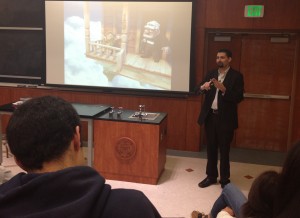
JoshBrahm-BodilyRightsSpeech-300x218 (1)I am convinced that most pro-abortion-choice advocates who go beyond basic rhetoric and slogans are partially grounding their position in some form of bodily autonomy arguments. If you’re somewhat new to arguments for abortion rights that admit for sake of argument that the unborn is a fully valuable person, please listen to this speech I gave at UCLA last month explaining them as well as offering some refutations.

Let me offer a brief summary of bodily rights arguments before getting to the faulty pro-life responses. Most pro-choice arguments either assume that the unborn are not valuable human beings, (“What about poverty?” “What if she will lose her scholarship?”) or they argue that the unborn are not valuable human beings. (“It’s not viable yet.” “It’s not sentient yet.” “It can’t feel pain yet.”) But there’s a third category of pro-choice arguments that admit (at least for the sake of argument) that the unborn are valuable human beings, yet the mother should still have the right to kill them because of her bodily autonomy. Her view is that if it’s in her body, she has the right to kill it, or at least take whatever measures necessary to refuse to have her body used as life support.

I’ve spoken on bodily rights arguments a lot, especially after helping write the De Facto Guardian paper. During Q&A, someone will often ask about a potential pro-life response that I didn’t include in the speech.

Here’s one I’ve heard several times in that context, and I’ve seen pro-lifers use it in blog posts as well:

“No woman has an abortion because she’s trying to protect her right to bodily autonomy.”