Abortion and Moral Culpability

One of our best tools in conversations about abortion is Trot out a Toddler (TOAT). It’s really helpful because it communicates how we need to think about unborn humans if we admit that they’re persons. Once you accept the conclusion that the fetal human is a valuable person like us, then it’s just as wrong to harm that child as it would be to harm a toddler. Even if there are difficult circumstances surrounding many abortions, if those circumstances wouldn’t justify killing a toddler, then they wouldn’t justify abortion, either. Often this helps the two people discussing abortion identify that they their disagreement on this issue isn’t due to a disagreement about how awful the circumstances of the world are, whether or not people who are suffering need our help, or anything of the sort. Rather, they disagree about the moral status of the unborn human.

Estimated reading time: 7 minutes.

There are some nice advantages of TOAT: it’s clear, simple, and reasonably effective. However, it also has a couple prominent drawbacks. Sometimes, TOAT causes pro-choice people to believe that we’re claiming that women who get abortions have both the same moral callousness and the same moral culpability as women who kill their toddlers. We’re not making either claim, but since we’re saying thing X is like thing Y in at least one way, unless we clearly say otherwise, it’s understandable for them to assume that we think they’re alike in other ways. People are fallible and often make assumptions (pro-life people no less than pro-choice people), so as the pro-life advocate is it good practice to clarify what you’re saying if you get the feeling that someone is misunderstanding you.

Just because it’s worth saying twice: we at ERI do not believe that women who get abortions are just like women who kill their toddlers. Even though the child who dies in each situation is of the same value, it takes a twisted heart to kill your toddler in cold blood, and that just isn’t true of most women who get abortions right now. Maybe it seems like I’m splitting hairs; if you’re pro-life, you probably consider it obvious that an unborn baby is just as much a person as an older child, and if it were obvious to everyone, then it would make sense for laws to be the same for both. But for a woman who’s been told that she is just getting a clump of cells removed because she can’t afford a baby, it’s not at all obvious to her that they’re the same. Women have been sold a lie about abortion in our culture. The messaging is politically and financially motivated, but it is a convincing message. And if trusted health professionals are offering her a way out of a difficult situation and telling her that no real people get hurt, she has no malice towards her child because she doesn’t think one is there. She probably wouldn’t get an abortion if she knew that it harms and kills a person. This is clearly and totally different from a parent who kills their toddler, whom they’ve raised and whose status as a person is not in doubt.

Refuting Pro-Choice Memes

Responding to Snark with a Winning Argument

Editor’s Note 9/8/21: More of these memes are circulating since the Texas heartbeat law went into effect on Sept. 1. We have updated the article with a few new photos and two new categories of pro-choice memes in order to bring it up to date with current events.

Your social media has probably been flooded in the past few weeks with memes and people talking about the recent state bills restricting or banning abortion. Usually I discourage pro-life advocates from spending a great deal of time talking about abortion online because I think that pro-life conversations are incredibly more productive in person. However, the amount of misinformation on social media about these bills and pro-life efforts is currently so widespread that I think it has tipped the scales far enough that pro-lifers have a greater than usual responsibility to publicly refute arguments.

Estimated reading time: 35 minutes.

Image: Man banging head on laptop. He probably just saw some memes.

Josh Brahm and I had previously hosted a webinar where we reacted to some of the most popular pro-choice memes, but there was just too much to cover in 60 minutes before we jumped into a Q&A session. Since there is some overlap in the images circulating, I have sorted the messages into 14 main categories and provided a few sample memes from each. To make your life as a pro-life advocate easier, I have provided example responses in blue font showing how I would reply if my friend posted a meme from that category.

I recommend you use my example responses as a template to work from rather than copying the response word for word. (If you do copy and paste them, you may need to use “shift+enter” to create the paragraph breaks where I have them in my examples.) You should also say something like “Hey, first name of person” before you comment because it is polite and it softens the response in a more personal way. People are people, even if they are behind a screen. In my opinion, “they say, you say” soundbite-style apologetics are usually not very persuasive, hence why we don’t teach pro-life advocates to dialogue like this way. However, when you are scrolling through social media, responding to every pro-choice meme from scratch can be utterly exhausting. Moreover, these responses are not written with the purpose of persuading the original poster; rather, they’re designed to respond to the online snark with a winning pro-life argument for the sake of other readers, so that the pro-choice position is not the only one being seen.

Click on any of the hyperlinks below to skip to that section:

  1. Hypocrisy Memes
  2. Distracting From the Issue
  3. You’re a Man/This is None of Your Business
  4. Biology 101
  5. Ways to Reduce Abortion Rates
  6. Prosecuting Women for Illegal Abortions
  7. The Case of Rape
  8. Common Ground: Memes That Misunderstand Pro-lifers
  9. Handmaid’s Tale Imagery
  10. Back Alley Abortion Arguments
  11. Bodily Rights Arguments
  12. Savita Halappanavar’s Death in Ireland
  13. Abortion Is Healthcare
  14. Libertarian Argument for Abortion

1: Hypocrisy Memes

These memes seek to point out the apparent hypocrisy of the pro-life movement. They can focus on anything from accusing pro-life people of only caring about children until birth to policing the term “pro-life” to stretch beyond the abortion debate to another issue, saying that if you were really pro-life then you would agree with them about X issue.

Editor’s Note 12/16/20: Read our article “Are Pro-Life People Fake Christians?” for a forceful response to the Dave Barnhart meme.

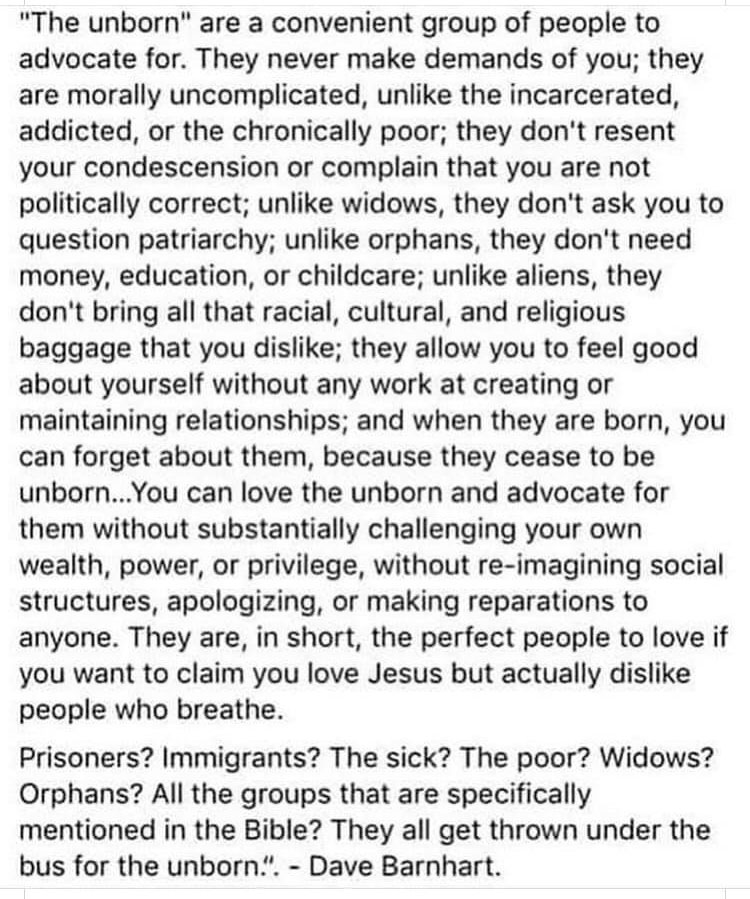
Image: One of 25 pro-choice memes in this article.

Image: One of 25 pro-choice memes in this article.

I want to share a thought from the pro-life perspective because I think it is important for people to consider the argument from all angles. If the pro-life philosophical arguments are true, then abortion takes the life of an innocent person. Since we are convinced of those arguments, we think that the life of the unborn child should be protected, regardless of their predicted outcome in life, just the same as we think the homeless, impoverished, or any other group of marginalized people have value and should be protected. The reason we focus on abortion is because we see it as legal killing, and, if our arguments are true, then it would be the most egregious, widespread act of violence in the history of the human race. We see it as that, and that’s why it’s our priority.

On another note, I want to push back on the charge that the pro-life position is primarily one of convenience because I don’t think it is true, especially since it is not socially popular to be pro-life. The pro-life movement has invested so much to care for pregnant mothers with counseling, free medical care, providing resources for the first few years after birth, and setting up networks that will connect them to other existing resources that will assist them, if needed, in the longer term. So, we do actually care for the child who is born beyond when it is “convenient” to do so, if it ever was. If I thought pro-life people didn’t do so, I’d be mad as well! There is also the unsettling idea that is present in the subtexts of posts like this: that if you’re not fighting for every cause then your work isn’t worth doing. I don’t see this accusation as legitimate, because if we do not have different organizations that specialize in different focus areas and everyone tries to do everything at once, we would never get anything done! The Red Cross shouldn’t focus staff time and resources to breast cancer research, and the Breast Cancer Research Foundation shouldn’t focus staff time and resources on help for people devastated by hurricanes and earthquakes.

Again, it all comes back to the basis of the pro-life view, which is that abortion is the killing of innocent people with the same worth as you and I. I think that it is important for people to interact with the philosophical claims on both sides of this issue, so I would love to talk more about that. Let me know if you’d like to continue this conversation. I’d love to keep talking so feel free to message me.

Personal Experiences Don’t Prove Anything

The Problem with Results-Oriented Reasoning

Estimated reading time: 10 minutes.

Most pro-life people have at least one major goal in common: we want to see abortion become illegal. So why do we disagree so much about how we should get there? Primarily, it’s that we have different beliefs about what is effective. If we all agreed that a given strategy had the highest probability of succeeding in the shortest amount of time, then we could probably all get on board with that strategy.[1]

There are many reasons why we disagree so much about what is likely to work. People have different experiences, different personalities, different strengths, different mentors, confirmation bias, misunderstandings, sin, and good old-fashioned stubbornness. It’s pretty difficult to do much about these things. But there’s another factor that contributes to our disagreements that we can actually do something about, because it is a very correctable error in reasoning: We have an ingrained impulse to be results-oriented. If we all learned to recognize that impulse, we would actually have fewer disagreements.

Being results-oriented means believing explicitly or implicitly that a given action is praiseworthy or blameworthy on the basis of the results of the action.[Tweet that] In other words, when someone is trying to evaluate the effectiveness of an action, an argument, a method, or anything else, they look at the results. If it had a positive result, they declare the action/argument/method to be effective. If it didn’t have a positive result, they declare it to be ineffective.

What to Do When the Utilitarian Bites the Bullet

What to Do When the Utilitarian Bites the Bullet

Estimated reading time: 3 minutes.

Helping someone change their mind about something often comes down to presenting them with a choice: change your mind or bite a bullet. In other words, demonstrate that their position requires them to accept a conclusion they really don’t want to accept. This is why a good thought-experiment can be so effective.

People are loathe to change their minds, so the more difficult the bullet is to bite, the better. I like to say that I want someone to have to bite an explosive round, something they can’t just tolerate and act like they don’t mind it.

Earlier this year I wrote about how I respond when people attempt to defend the pro-choice position by appealing to utilitarianism. I start by responding with a straightforward thought-experiment:

Suppose a given person has a healthy heart, lung, kidneys, bone marrow, and blood. By kidnapping him, we could save five people or even more by distributing those body parts to other people that need them. Should we do it? Or what if it’s just one person that we can save, but it’s a more important person? Should we kill a homeless person if it means we can save, say, an important scientist?

This is a tough bullet to bite, but sadly, for some, it isn’t tough enough. Some people struggle to think clearly about murder. I suspect this is because when it comes to killing people, there are exceptions. You can kill in self-defense, most people believe you can kill in war, and while it’s more controversial, many believe you can kill in capital punishment. My colleague Rachel Crawford has also pointed out to me how deeply confused people are about revenge. Revenge stories are popular in books and film because we’re sympathetic to the avenger. It feels just for the wrongdoer to be punished in an act of vengeance. All of these problems make any thought-experiment about murder a little less effective.

But there are other actions that virtually everyone think have no exceptions, such as rape. Most people think rape is wrong, not just generally, but every single time. Utilitarians find it much harder to bite the bullet on rape. Here’s the thought-experiment I use after they bite the organ-theft bullet:

When Is Abortion Fetal Euthanasia In Disguise?

Image: Euthanasia needle and gavel

Estimated reading time: 10 minutes.

Bioethics is a broad and expanding field of ethical inquiry into questions concerning human life, its beginning and end, and its interaction with medicine and other technologies. When I began my formal study of bioethics, I noticed that many issues were interrelated, and the issue which had perhaps the most implications for the resolution of any other was the question of abortion. For example, a pro-life disability ethic is able to recognize that ableism begins prenatally, which prompts measures to protect fetal humans from discrimination on the basis of disability. It occurred to me only recently that, in at least some cases of abortion, the parents believe that they are aborting the child for its own good. That is to say, while abortion is the method by which the fetus is killed, the parents are really looking at the question through the lens of euthanasia.

There are many reasons why parents (or society) may believe that it would be better for a child if he or she wasn’t born. Often, the reason is a medical condition. There are cases in which a child will not survive birth, or in which the child will have a very brief and painful postnatal life. Another issue is that of prenatal diagnosis of disabilities, in which people argue that the child’s quality of life would be so low that it is hardly worth living.[1] At times, economic factors may come into play. At least in conversations on college campuses, the possibility of hardship by way of the foster system is a concern. A lot of these concerns are understandable; people want their children to avoid pain, on the whole, and to have happy lives. But the desire to avoid pain and promote happiness is a questionable justification for depriving someone of life.

These concerns about the quality of a fetal human’s life after birth animate two different lines of argument. I want to distinguish between how each argument functions and give a response to the primary issue underlying each one. In each case, I’m going to assume a scenario in which a child has a disease which lowers the chances of surviving through hospital discharge and which would likely cause the child to have some amount of pain for the rest of its life.