Six Ways I’ve Seen Pro-Choice People Try to Censor Pro-Lifers

Estimated reading time: 11 minutes.

Abortion is not merely immoral, it is obviously immoral.

This is why I’m so dedicated to helping pro-life people learn to dialogue well. I want all pro-life people to use the most persuasive arguments and learn to communicate graciously, relationally, and clearly. Those components in combination are an incredible recipe for the kind of environment where pro-choice people change their minds about abortion.

That abortion is obviously immoral is also why I’m open-minded. Some people think that being open-minded means being wishy-washy, and that couldn’t be further from the truth. Being pro-life and open-minded means being pro-life because it’s rational, not because it’s comfortable. I’m pro-life because rationally it’s what I have to be, not because it’s what I want to be. If somehow my arguments against abortion were defeated and a stronger argument for abortion was presented to me, then I would change my mind.

Any open-minded person should be disgusted whenever people try to silence their political opposition.[Tweet that] I’m almost never disgusted with pro-choice people. I honestly think most of them mean well, but suffer from a combination of self-deception, flawed reasoning, and difficult emotional experiences. But I become truly angry when anyone attempts to shield himself and others from hearing arguments against his view by preventing his opposition from speaking.

I want to defeat pro-choice arguments by presenting better arguments, but I want the opposing arguments to be made. Sometimes I even help pro-choice people make their arguments stronger before I present my own. I believe the more light that is cast on both views, the more clearly the pro-life side comes out the victor.

Censorship attempts to prevent one of the sides from being visible. Censorship doesn’t want people to choose the more compelling view, it wants to force people into only having one view to choose from. Censorship is an incredibly powerful weapon for anyone cowardly enough to use it.[Tweet that]

Honest dialogue is aimed at truth, which makes it the greatest friend of the truth-seeker. It is created by two people being willing to acknowledge that they have been wrong before and that they want to believe true things, no matter how uncomfortable. Censorship, on the other hand, is the greatest enemy of the truth-seeker.

Censorship is at its strongest when it is hidden in the shadows, so out of a desire to make it as weak as possible and make it easier to recognize in the future, I am going to briefly share six experiences (or types of experiences) where I have seen attempts to censor pro-life people.

Unfortunately the attempts at censorship are getting more and more common. I’m not afraid of pro-choice arguments, but I am afraid of a political climate that trains people to refuse to even listen to pro-life arguments. If enough people are brainwashed to only listen to people that agree with them, we will not be able to stop abortion.

All six of these experiences are of pro-choice people doing the censoring. I’m not saying that censorship doesn’t exist on the other side, but I do think it is significantly less common. I formally renounce all attempts pro-life people have ever made to censor pro-choice people. Let them speak. If the truth is on our side, what have we to fear?

Why Pro-Life Advocates Are Not Responsible for the Planned Parenthood Shooting

Many pro-choice people have responded to the recent shooting by blaming pro-life advocates. In this article I show why such claims are completely unjustified by analyzing culpability and what it means to incite violence.

Estimated reading time: 14 minutes.
Photo credit: Colorado Springs Police Department

Photo credit: Colorado Springs Police Department

Last Friday a 57-year old armed man named Robert Lewis Dear walked into a Planned Parenthood facility in Colorado Springs and opened fire. He barricaded himself inside for hours, and before surrendering himself to police he killed three people and wounded nine more.

Ben Domenech at The Federalist summarized many of the weird things that have already come out about Dear:

As is so often the case in these circumstances, Dear is described by neighbors as an odd loner, who avoided eye contact and spoke unintelligibly. In South Carolina, his previous residence, he had been arrested after hiding in the bushes and peeping into his neighbor’s house. He shot a neighbor’s dog with a pellet gun and threatened him with bodily harm. In Colorado, he lived off the grid in a trailer, on a five-acre plot of land he apparently purchased for $6,000 in 2014. This followed a series of cabins and trailers — without electricity or running water — that he stayed in after his divorce in 2000.

Dear has no history of affiliation with the Republican Party or pro-life groups or politicians.

While we don’t yet know very many details about his initial questioning by police, it was leaked that he said something about “no more baby parts” at some point. This is a clear reference to the Center for Medical Progress’ (CMP) undercover videos that have provided evidence that Planned Parenthood illegally sells body parts from the babies they kill in abortion. Planned Parenthood and others are claiming or implying that pro-life advocates are partially to blame for the shooting because we have been saying that Planned Parenthood sells baby parts.

Are pro-life advocates culpable for the shooting? By culpable I don’t mean “the only person to blame,” or even “the primary person to blame.” I also don’t mean “ought to be legally prosecuted.” By culpable I mean “morally blameworthy for their actions.” Whether pro-life advocates are culpable for the recent shooting depends entirely on what it means to incite violence. While I will not answer every possible question about what circumstances could make one culpable, I will argue that there are two extreme ways of thinking about culpability that we should avoid. I will also argue that the right way to determine if a statement incites violence is to examine the statement, not merely whether or not it was credited for violence.

Let’s start by examining four fictional cases.

Bring Structure to Your Dialogues by Making Little Agreements

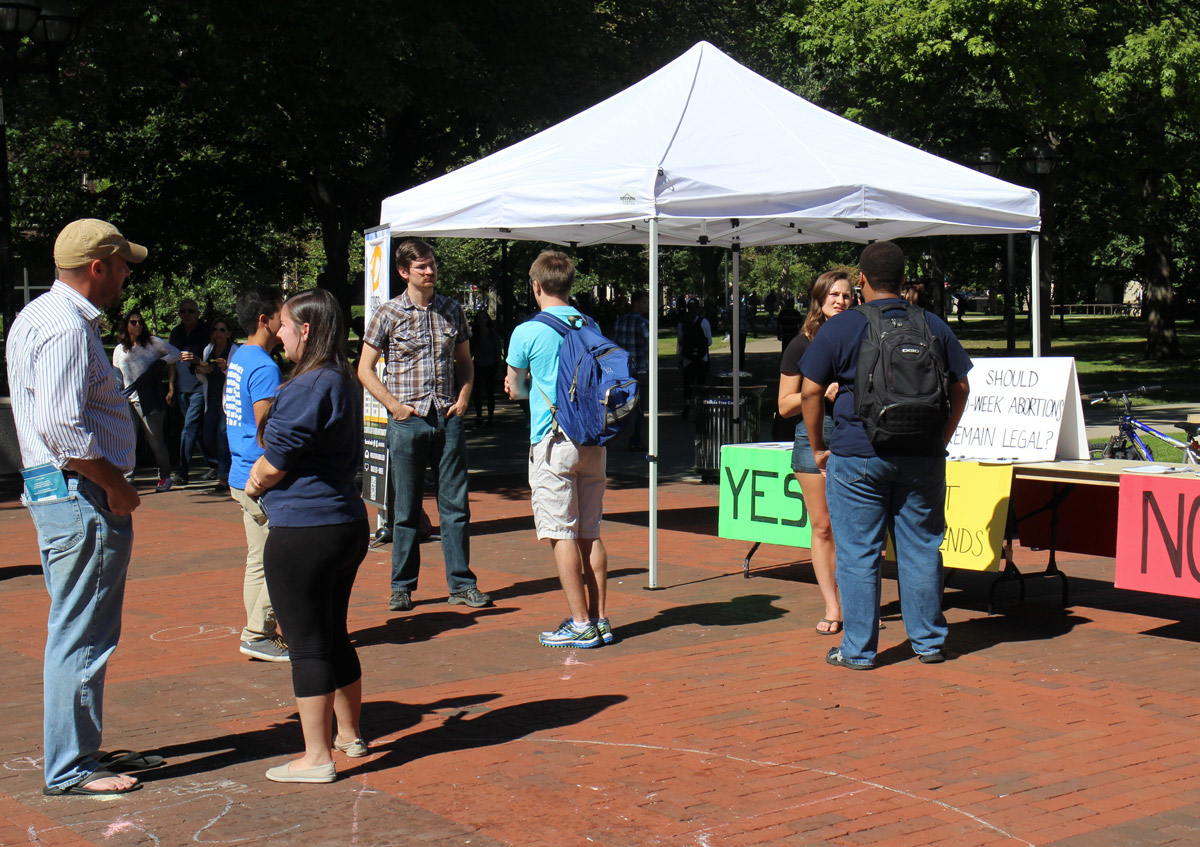
In the spring of 2013 I was standing in front of the Justice For All Exhibit at Colorado State University, trying to start conversations about abortion. I was struggling that day because most of the time I tried to invite someone into a conversation, they reacted suspiciously. I decided to try something different.

Estimated reading time: 4 minutes.
Photo credit: Justice For All. Used with permission.

Photo credit: Justice For All. Used with permission.

Four girls walked past me and I called out, “Hey, would you like to share your opinion about abortion?” Three of them ignored me and kept walking, but one of them, who I’ll call “Jill,” turned and paused, trying to decide if she wanted to take the bait. Her friends, now a couple of yards ahead of her, called back, “Come on, you don’t want to talk to that guy!”

I looked Jill right into her eyes and said, “If I promise to only ask clarification questions to try to understand your view unless you give me permission to do otherwise, will you talk to me and share your view?”

She thought about my offer for a few seconds and then hesitantly said, “okay,” and walked over. For the first ten minutes of our conversation we discussed difficult circumstances women find themselves in, and the nature of the unborn. She made some indefensible claims about embryology, the kinds of claims I couldn’t correct without making statements. I asked her if I could make some statements to clarify some things she was getting wrong, and she easily said “yes.” It only took me a few minutes to show her I was compassionate and reasonable, so by then we had built enough rapport and trust that she was willing to listen. Jill had to go to class about fifteen minutes later, but we had a valuable twenty-five minute conversation in which I helped her to understand why people like me are pro-life and what the unborn are.

Responding to the Astute Observation That I Am a Man

Estimated reading time: 5 minutes.

Any time I go to a college campus to do a pro-life outreach, I can count on three things: 1) I will forget to wear sunblock, 2) I will not drink enough water, and 3) I am going to be reminded that I cannot get pregnant. Inevitably, then the pro-choice person will ask, “how can you have an opinion about abortion when you can’t get pregnant?”

While I do not consider this to be a significant intellectual challenge, it does make for a very important rhetorical challenge. I have seen the fate of many a conversation hang on how well the pro-life man responds to this question. His goal cannot merely be to give a logically valid response. In order for the conversation to remain productive, he must be reasonable, and he must be winsome. [Tweet that!]

It should be obvious that saying men can’t have an opinion about abortion is, at a strictly logical level, merely an ad hominem argument, an attack against the person. It is also about as clear an example of sexism as I have ever seen. But the pro-choice person that is inclined to use this argument does not see it that way. Logically speaking, it is that way, but trying to convince her of that is quite a gamble in my experience.

Is Abortion Justified by an Inalienable Right to Sex?

I wrote an article two weeks ago describing the first part of my conversation with a student I’m calling “Brent.” If you haven’t read it yet, I’d encourage you to check that out first. It has the first half of this story as well as four practical dialogue tips I think you’ll find helpful in your conversations.

Estimated reading time: 9 minutes.

IMG_0224-Blog

Trigger warning: This is a story of me grappling with the view Brent had that abortion is necessary so that people can have sex without consequences. I challenged Brent to change his view with a thought experiment. I had to push Brent pretty hard though, and the thought experiment became pretty grim. If you’re sensitive to dark thought experiments involving born babies being killed, this may not be the article for you.

I had a suspicion that there was a part of Brent’s view that we hadn’t talked about yet, so I took a chance and asked him:

Tim: I have a guess about something that’s going on in the background for you. Do you think people have a fundamental right to have sex?

Brent: Yeah I do. It’s like, one of the most important things in life.

Tim: That’s really interesting. I think if the right to have sex is inalienable and if limiting that right is immoral, then you’re right, abortion does needs to be legal. Birth control fails sometimes, and sometimes people don’t want to have kids. In order to protect an inalienable right to sex, legal abortion is necessary.

Brent: Yes, exactly. And it’s especially necessary for women to have equality. Men can have sex without being forced to take care of children, they can skip out, but women need abortion to be equal.

Tim: Yeah, I think this is an important point, and I think it’s one of the reasons people want so strongly for abortion to be available. The way pregnancy works, it doesn’t create symmetrical responsibilities for men and women. You can curse God if you want, maybe it isn’t fair, but you’re right, it’s not symmetrical. This is one of the reasons I’m strongly in favor of harsher punishments for men that don’t pay child support. Given this asymmetry, a just society should compensate by protecting women from being taken advantage of. It’s similar to how a just society should respond to the fact that men are generally physically stronger than women by working as hard as it can to stop men from assaulting them, sexually or otherwise.

Brent: Yeah, that makes sense.

Tim: I don’t think the right to have sex is the kind of fundamental right that justifies killing children though. Sex is important, but the right of one person to live has to be above the right of another person to have sex.

Brent: I disagree. Stopping people from having sex is like slavery. It shuts down their ability to live life in a human way.