Relational Apologetics Tips: How to Cultivate Friendship Amidst Challenging Conversations

Estimated reading time: 5 minutes.

Equal Rights Institute is Relational Apologetics focused on teaching pro-life advocates practical dialogue tips, rigorous philosophy, and relational apologetics. When we use the phrase “relational apologetics,” we mean trying to change a person’s mind about a core belief in the context of genuine friendship.
Most people will not change their minds about a serious subject after one conversation, so an ongoing dialogue with a friend can be really helpful.

When I speak about relational apologetics, I usually illustrate with the story of my friend Deanna Unyk, who began dialoguing with me about abortion two years ago, and began self-identifying as pro-life one year ago.

Click here to read what changed Deanna’s mind about abortion. If you want to learn more about why I think guy-girl friendships can be virtuous, God-honoring friendships, and what boundaries I think should be in place, click here.

When the pro-life club at the University of Portland heard Deanna’s story, they asked Deanna and me if we would be willing to do a public discussion about relational apologetics (in addition to being a great opportunity, this was also a personal blessing because it gave us the chance to finally meet in person). We sat on stage, told our story, and encouraged the audience to cultivate friendships among people with whom they had serious disagreements. The event was a great success, with around 80 in attendance from both sides of the abortion debate. Many people came up afterwards, saying that they had never been to an event like this, and that it helped them to think about abortion and relational apologetics in a new way.
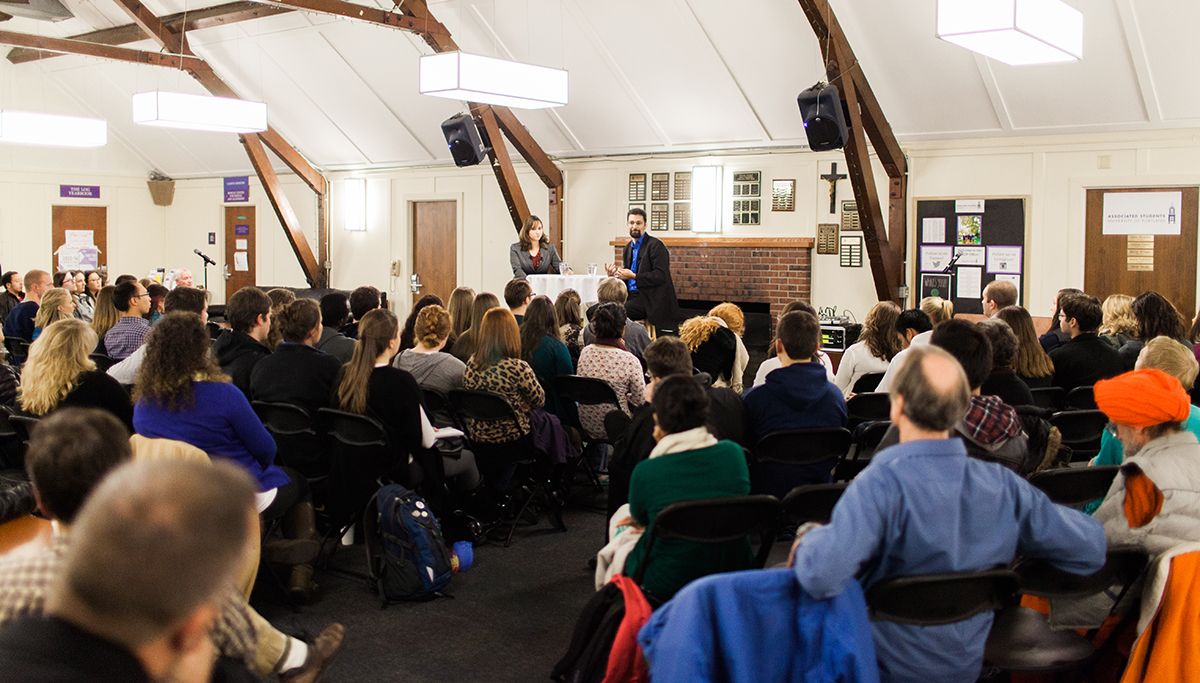
Photo Credit: Andie Jael

Photo Credit: Andie Jael

During the event, Deanna and I offered practical tips for cultivating friendships with people who disagree with you about important issues. Here are a couple of my favorites:

Our Experience at the OMSI Prenatal Exhibit Displaying Real Preserved Children

OMSI Prenatal Exhibit

Photo credit: M.O. Stevens. Creative Commons license.

Estimated reading time: 10 minutes.

Trigger warning: This post details our experience of going to a museum exhibit that featured preserved bodies of actual miscarried unborn children. None of them were aborted. Their bodies are whole and carefully preserved. Depending on your sensibilities/past experiences, the descriptions and/or pictures of the exhibit that I’ve included may be a trigger for you.

Last year during my first speaking trip in Portland somebody told me that I couldn’t leave without seeing the Prenatal Exhibit at the Oregon Museum of Science and Industry, or OMSI. Due to scheduling reasons I couldn’t pull it off, but I called the museum a few weeks ago to ask whether the exhibit was still there. Upon finding out that it’s there until May 6, I made sure that my staff and I had time to visit the exhibit during our recent trip to Portland where we trained the student club from Portland Community College with a seminar followed by a two-day outreach on their campus.

The exhibit was created by Dr. Gunther von Hagens, the person behind the controversial “Body Worlds” exhibit. He uses a plastination technique to preserve animal and human bodies and sets up exhibits in an effort to educate people about anatomy in a way that books can’t. The exhibit is controversial because in the case of the human bodies, these were real people who arguably should have been buried. My staff and I have unresolved concerns about that aspect of it.

In the case of the prenatal development exhibit at OMSI, they only have babies who were miscarried and then preserved, presumably with the parents permission. (This exhibit isn’t to be confused with “Bodies: The Exhibition,” which is similar but whose bodies all came from China, adding to the controversy.)

On Understanding the Baltimore Rioters

A friend of mine posted a question on Facebook asking for help understanding why people in Baltimore are rioting. Here was my attempt. Interested in additional thoughts from all over the political spectrum.

—————–

Okay, here’s my best shot. The more peaceful protesters are black people who feel like the lingering societal effects of slavery and segregation still last, resulting in it being harder for them to get good jobs, live in nice neighborhoods, etc.

There has been a lot more documented police brutality than before when cell phone videos weren’t a thing, and some police agencies aren’t responding appropriately to that. This means that they feel real physical danger when stopped by police.

They also believe that unlike white, privileged people, their voices aren’t really heard, so they do the next “louder” thing: get together and protest, *just like we do in DC every January!*

The violent rioters? I think some of them are described above but their feelings about it are so strong that it has turned to anger and even hatred of police/the government/anyone they believe is too powerful.

I think there’s a third group of people who just want to watch the world burn. They don’t care so much about racism and police violence as they do the fun of participating in a riot and burning stuff.

When and How You Should End Unproductive Conversations

Estimated reading time: 7 minutes.

It is one of the questions I’m asked the most often. We’ve all experienced it. You’re talking to someone about abortion or something else and it’s just not going very well. You start doubting whether any good will come from letting the dialogue continue.

If you do decide to end the conversation, you have to figure out how to graciously bring the dialogue to a close, which can also be tricky.

How do you know? What factors should you consider?

Before ending any conversation you should ask yourself, have I used the “three essential skills of good dialogue” today? Steve Wagner at Justice For All believes the three essential skills of good dialogue are:

  1. Asking good questions.
  2. Listening to understand.
  3. Finding genuine common ground when possible.

You can hear me explain the three essential skills in the video below, from 4:41 to 17:43.

If you haven’t used the three essential skills, that very well may be why the dialogue isn’t going well. I’d encourage you to say, “Can we take a moment outside of the debate? I think it’s really important to listen well and not just be thinking of your next argument, and I haven’t done a good job of that today. I want to ask you to do two things. Forgive me for being ungracious to you and not listening to you well. Secondly, I’d like to ask you to give me another chance. Tell me what you believe, and I promise to try to really hear you.”

But what if you have used the three essential skills? Are there some dialogues that are not worth continuing?  Yes.  Is it easy to tell which conversations you should bring to an end? No. 

Meet Our Newest Staff Member!

IMG_2706

We have a new staff member! We’re so delighted to introduce Kim Bagato to you, although if you’re in the Central California area, you may have already been blessed by Kim’s work at KRDU or Salt Magazine. Today is her first day at taking administrative tasks off of Josh Brahm’s plate so that he can focus on what he does best: growing the organization, leading the staff, speaking, writing and raising the funds we need to accomplish our goals.

Click here to learn more about Kim.