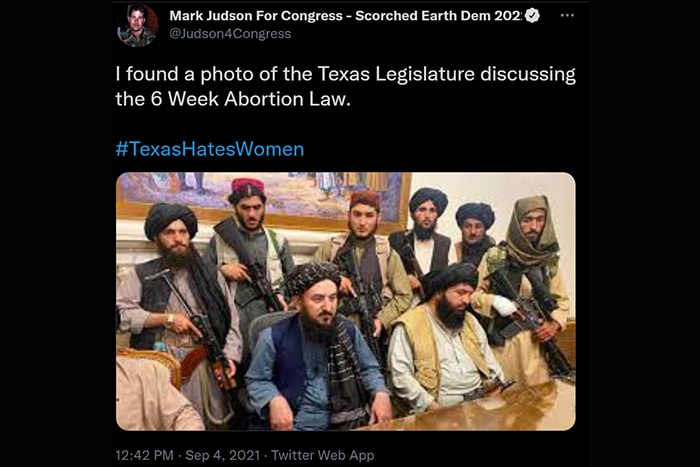
“No uterus, no opinion.” Yeah, we’ve all heard that one before. I spent years training my male pro-life club members how to respond to the charge that men shouldn’t have an opinion about abortion. It came up in every single outreach we did; I’d overhear my co-president Joshua or male club members like Oscar having to defend why they should even be allowed to open their mouths about this controversial topic in the first place.
But then something happened that I never saw coming: pro-choice people started telling ME that I shouldn’t be allowed to have an opinion about abortion. Um, I’m a woman! I have a uterus!! It took me a little time and a lot of clarification questions to figure out what was going on.
Are you in a pro-life group? Interested in starting one? Learn from our team of expert pro-life advocates how your group can make an impact for life in your community. ERI Affiliate Groups are pro-life groups of all sizes and types who come together around ERI’s unique approach and apologetics materials in order to maximize their effectiveness in pro-life advocacy.
Are you a college club? Church group? Youth group? High School group? Right to Life club? Sidewalk Counseling group? Community group?
Are you just starting out? Already have over 100 members?
All are welcome here.We’ll meet you where you’re at and be here for every step of your journey. You’ll receive:
One-on one, personalized mentoring from one of ERI’s Club Coaches to help your pro-life group reach its full potential.
Preferential access and discounts to ERI speakers for events.
A set of 50 complimentary ERI Outreach Brochures to use at your club’s outreaches and/or sidewalk counseling after completion of the Equipped for Life Course.
Private access to our library of ERI Digital Kits with tips and how-to-guides for running an active and effective pro-life group. Kit topics include:
Creating a Professional Club Brand
Recruitment & Retainment
Running Meetings that Keep Your Members Coming Back
Fundraising 101
Starting a Pro-Life Outreach
Designing Your Own Pro-Life Display
Your Club on Social Media
Hosting a Pro-Life Speaker
Taking a Trip to the Abortion Facility
Building Relationships With Your Local Pregnancy Resource Center
This book review of After Virtue by Alasdair MacIntyre is part of our series of reviews of books touching on the abortion debate. For more information about this series, read our introductory article, “Why Is ERI Doing Book Reviews?”
Name-calling isn’t new. It’s been a classic bullying and teasing tactic amongst children for centuries, and while our education system tries to eradicate such childish behavior before adulthood, we’ve clearly failed on this one. If you’ve sneaked a peek at any social media website, you’ve certainly noticed that adults show about as much maturity as your average middle schooler in this department. The abortion debate, in particular, brings out the worst in people, and you can find a whole host of names and labels being thrown around from “anti-life” and “baby killers” on the one hand to “anti-woman” and “forced-birthers” on the other.
While few pro-choice people are actually using terms like “forced-birthers,” many have adopted the term “anti-choice” in order to avoid referring to us as standing for life. Many pro-life people have decided to reclaim the term in response, openly embracing their view as being “anti-the-choice-to-kill” or something like that. A few weeks ago, we received a comment on our YouTube Channel pointing out precisely that:
This comment really got me thinking: How should we respond when someone calls us “anti-choice?” When is it helpful to debate labels, and when is it really just a distraction from the issue at hand?
One deeply unfortunate requirement for publishing useful online content is staying informed of current events. I generally despise the modern news media—not even primarily for its ideological slant, but because the constant churn of the “news cycle” and the need for more negative fuel is partially responsible for making those who watch it become worse people.
Fittingly, one of the places this is most evident is in the comment sections of online publications, particularly those which address politics. If news media itself attracts shrill demagogues, the comment section is home to screeching sycophants. If the publication in question has any ideological inclination, commenters largely consist of the most vitriolic elements of that base and provocateurs from the opposition.
My days as a keyboard warrior are behind me. I generally consider comment-section arguments in general to be nearly worthless, and this is most true of comment sections on news publications. Although I haven’t commented in ages, I still read comments too often, either to look for people to agree with my thoughts (a rare occurrence) or because I dislike myself and apparently desire needless emotional harm (much more frequent).
In this case, I delved into the comment section of an article for research. I’m cynical by nature, and believe comment sections are cesspools, but I was surprised by just how awful the comments I discovered proved to be. This was the worst comment section I’d seen, but I have no reason to believe it is particularly atypical or that it doesn’t represent our partisan furor accurately.
I’m going to respond to several screenshots from the article in question, and along the way I hope to provide some tips for those who want to engage with others on the internet. Again, it’s bad and uncensored, so consider this your warning before you proceed.