
“No. The definition literally says a parasite must be a different species than its host.”
When a pro-choice person in my social media comments claims that a fetus is a parasite, I watch countless pro-lifers pounce on them with the “just Google it” mic-drop.
There’s two big problems with this approach.
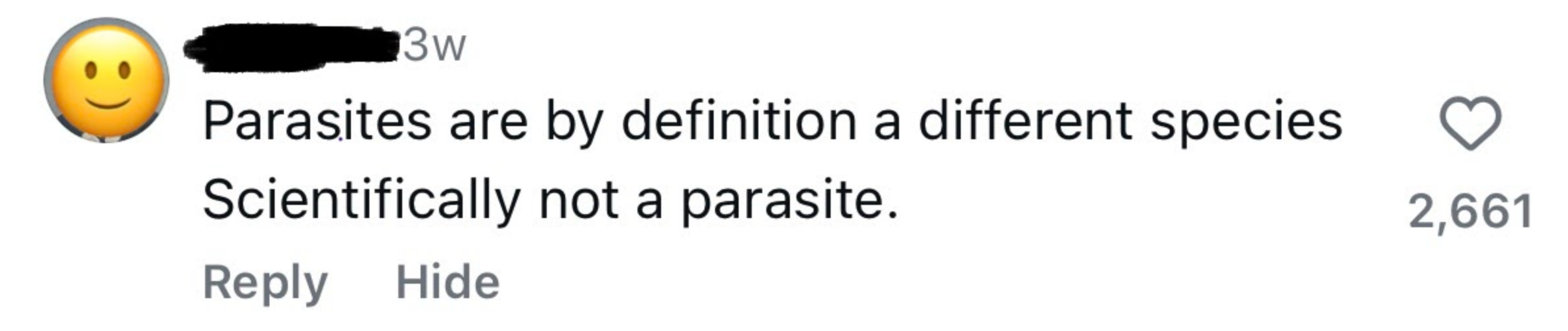
The Definition Usually Doesn’t Say That
When I “just Google it,” the AI overview that pops up says “A parasite is an organism that lives on or inside another organism (the host) and gets its food from or at the expense of its host. Parasites harm their hosts and can cause diseases, such as malaria. The term also describes a person who relies on others, providing nothing in return.”
The first website underneath that section is the Cleveland Clinic: “Parasites are organisms that depend on a host to survive and spread.”
Then the CDC: “A parasite is an organism that lives on or in a host organism and gets its food from or at the expense of its host.
Then Centro Médico ABC: “A parasite is an organism that lives in or on another organism, known as the host, from which it derives benefits such as nutrients or shelter, and it may cause harm to the host.”
It took me until the ninth entry on Google to finally get: “An animal or plant that gets nutrients by living on or in an organism of another species.” (emphasis mine)
“Just Google it” reveals that most definitions of “parasite” from reputable medical groups don’t include the different species requirement. And I don’t think this is crazy; scientists widely agree that cases such as angler fish constitute same-species parasitism. So “it has to be a different species” isn’t an accurate rebuttal to the claim “a fetus is a parasite.”
They Might Mean it Metaphorically
But I think the bigger problem with the “just Google it” response is that it often misunderstands what the pro-choice person meant by “a fetus is a parasite” in the first place.
Remember that AI overview from Google? “…The term also describes a person who relies on others, providing nothing in return.” That is what I find most pro-choice people mean when they call a fetus a parasite.
They aren’t trying to claim that a fetus is literally a parasite. They are trying to claim that a fetus is like a parasite in a lot of relevant ways. A fetus takes nutrients from the mother, often making her very sick in the process. Pregnant women can be exhausted, nauseous, sore, dizzy, bloated, and gassy. She requires a higher calorie intake to keep up with what’s been sapped from her to take care of this fetus that didn’t ask permission to steal her nutrients. She can have headaches, bleeding gums, cramping, shortness of breath, dry skin, backaches, heartburn, constipation, swelling of hands and feet, insomnia, and carpal tunnel syndrome.
Sure, a fetus might not literally be a parasite, but it sure sounds a lot like one. For the pro-choice people I’m talking to, nobody should have another person or thing feeding off of them, causing them this much pain and suffering, without their consent. She should be able to get that thing removed, just like she can get medical treatment to remove an actual parasite.
Why I Care
As a pregnant woman currently laying in bed from dizziness and uncontrollable nausea as I’m writing this…I’m not going to lie. At 12 weeks pregnant, it feels like something has majorly gone wrong in my body. No, a fetus is not a parasite, but comparing a fetus to a parasite isn’t as insane as pro-life people would like to think it is.
That’s why, anytime someone I’m talking to claims a fetus is a parasite, I start by asking this clarification question:
Me: “I want to understand your view. Do you mean that a fetus is literally a parasite, like biologically it fits the definition? Or do you mean something more metaphorical, like a fetus is really similar to a parasite in that it takes her nutrients without her consent?”
I’d estimate 80% of the time, it turns out that they mean the second thing.
Them: “Right! I don’t know what the definition is. I just know that women should not be forced to donate their body to something that’s basically feeding off of them!”
Essentially, by calling a fetus a parasite, they’re pointing to something we call the Right to Refuse argument. They’re saying that “what the fetus is” isn’t really the important question. It doesn’t matter because no one should be forced to let another entity use their body without their consent—regardless of whether the entity is a human person, a parasite, or something else entirely. A woman always has the “right to refuse” the use of her body to something or someone that is trying to use it. Especially something or someone that is causing her pain and suffering.
Once I’m clear that that’s what the pro-choice person I’m talking with is saying, I spend several minutes talking about why that idea makes a lot of sense to me. I’ve been pregnant twice, and pregnancy can absolutely feel like a foreign object has taken over your body. You can get super weird symptoms. There’s comparisons you can make between a fetus and a parasite, absolutely, and I generally agree that people shouldn’t be obligated to help others with their bodies. But ultimately, the difference is that abortion isn’t just “not helping” another person with your body. It’s killing an innocent person. And that’s wrong.
If you want the details of the reasoning I use with pro-choice people to argue for that claim, we’ve published how to respond to the Right to Refuse Position many, many times, so pick whether you want a video, article, or reel from one of the links I just dropped.
But What if They Really Do Mean Biologically?
What we haven’t really published on before is the biological question. If I ask the clarification question and they confirm that they really do believe a fetus fits the biological requirements of a parasite, it’s time to dig into the biology of pregnancy. I’ve been tagged in several science-y social media influencers’ videos recently, so I made a reel explaining 10 reasons why a fetus isn’t a parasite.
What a Parasite Is:
- You never make your own parasite from your own DNA. I can’t link a source on that because it’s literally not a thing. It doesn’t exist.
- You don’t have specific organs whose only purpose is to house a parasite.
- Parasites are a class of species, so something doesn’t “grow out of” being a parasite such that it isn’t one anymore. Thus, an embryo can’t be a parasite and then grow into an infant that isn’t a parasite anymore. It is possible for parasites to evolve over thousands of years to no longer be parasites, but this is rare (and slow!). Parasitism is usually an “evolutionary dead end” because parasites lose the genes they need to live independently. They most certainly do not have the ability to become non-parasites within a span of 9 months.
- Parasites offer no benefits to their host; women actually do experience health benefits from pregnancy, and many of these are extended or heightened by nursing. Such long-term health benefits include brain growth, increased empathy, increased productivity, decreased risk of breast and ovarian cancer, decreased risk of multiple sclerosis, decreased risk of heart disease, and—particularly in case of a vaginal delivery—easier periods. This is without fully studying the potential benefits of the fetal cells exchanged with the mother, which could offer regenerative or other benefits.
Miscarriage and Birth:
- If a fetus is a parasite, then when I gave birth to my first baby, that was a sign my body is a failure. My body failed at defeating a 9 month parasite invader.
- And reproduction itself is a failure then, as if our bodies have some biological imperative to not reproduce!
- If a fetus is a parasite, then miscarriage is a success story. We’d be telling loss parents that their bodies were just way better at “defeating” their “parasitic” children than the bodies of parents who got to bring their live newborn babies home. That’s a horrific thing to say.
What Happens in Pregnancy:
- Our bodies do want to reproduce; my body has spent the last 15+ years specifically trying to make pregnancy happen. Females release an egg cell on a monthly basis for literally decades. As ovulation approaches each month, my body starts preparing a good environment for pregnancy by thickening the uterine lining so it will be ideal for binding a blastocyst and thinning cervical mucus so sperm can penetrate easier.
- Then when the egg cell does release, it includes a sperm-binding receptor called a ZP3 glycoprotein specifically trying to find a sperm to create an embryo.
- Once the sperm does penetrate the egg, the egg gives off calcium ions to cause a cortical reaction to prevent polyspermy, which is when more than one sperm penetrates the egg and the resulting cell isn’t viable. Polyspermy would result in the embryo dying, but my body specifically doesn’t want the embryo to die, so it releases calcium ions to prevent death.
I have never, ever had to go into more than one of these categories when I’m talking to a pro-choice person in real life. They always pivot pretty quickly to the Right to Refuse Position; they drop the claim that a fetus is literally a parasite and transition to metaphorical language. And I encourage them to! After talking through a few of these biology facts, I’ll say something like:
“It seems pretty clear that a fetus isn’t literally a parasite, but I do think parasites and pregnancy have things in common. I mean, when we think about parasites, we think about something taking someone’s nutrients and making them sick, and that definitely has similarities to pregnancy.”
Pro-choice people aren’t expecting pro-lifers to admit that pregnancy is hard. Understandably, our movement usually chooses slogans and images that make pregnancy look beautiful, attractive, and doable. We want to empower women to choose life. I’m not saying we shouldn’t use those slogans and images; I’m just pointing out that our public-facing messaging rarely digs into the reality that every pregnancy—even a planned, healthy pregnancy in a committed relationship in a financially stable situation—every pregnancy involves some level of pain, suffering, and difficulty.
When responding to the claim that a fetus is a parasite, don’t shy away from the hard realities of pregnancy. If they’re confused about biology, then definitely gently explain the scientific facts, because a fetus is not a parasite. But do that while acknowledging that the metaphor isn’t crazy. Take a few minutes to talk about some common ground: maybe share about any experiences you’ve had with difficulties during pregnancy, or how you believe we need better medical care for pregnant women, or local and government programs you’d support to help pregnant women and parenting families. And then, you can respond to the Right to Refuse Position by arguing that the genuine difficulties of pregnancy don’t justify killing an innocent person.
The post Is a Fetus a Parasite? originally appeared at the Equal Rights Institute blog. Subscribe to our email list with the form below and get a FREE gift. Click here to learn more about our pro-life apologetics course, “Equipped for Life: A Fresh Approach to Conversations About Abortion.”
