What Our Recent Survey Tells Us About Abortion Dialogue

Several months ago, we asked people who follow us and a number of other pro-life groups to take a survey about dialogue habits. We wanted to analyze the ways people approached conversations about abortions on different platforms and see if there were measurable relationships between medium, conversation length, and effectiveness.

Estimated reading time: 6 minutes.

In total, we received 134 responses from people with all sorts of different backgrounds in dialogue. If you responded, thank you! Because this was a voluntary, non-representative survey sample, the results don’t have ironclad scientific value, but they should still contain valid information about general trends.

The two main relationships we looked at were: 1) conversation medium (social media, private messenger, in person, etc.) and conversation length (number of messages/minutes); and 2) conversation length and how often the other person’s mind changed. We broke the last category up into four parts, based on the intensity of change (no change, minor change, moderate change, and major change).

The next couple of sections are going to be heavy with statistics, so you can skim it if you’re not curious about the data itself and just want to see what it means in the analysis section. If you want to see me show my work or you just enjoy stats, read on.

Let’s Talk About Disagreeing With Each Other

Let’s talk about having disagreements for a second. Disagreements about topics that make you so angry you feel like your passion could start a fire, or give you a heart attack. The ones that break your heart, that keep you up at night. Issues that have personally touched people you know, maybe the ones closest to you. The ones you lose friendships over, have broken ties, and burned bridges over.

Estimated reading time: 5.5 minutes.

Nicole Hocott at the March for Life in the nation’s capital.

Everything I say in this blog post is going to be based on this assumption: If you’re reading this, then you truly care about these issues and want other people to care as well. You want the best for those you disagree with in the following way: You want them to see your side because you believe it’s the truth. If you don’t care about convincing others of the truth, well, you should. But I won’t touch on that right now.

We all have certain topics that make our blood boil. In this post, I want to consider what our response should be to these. Let’s take a minute and step outside of any specific disagreement to look at disagreements in general. Let’s look at a few different options.

Don’t Blindly Use Statistics in Dialogue

A few years ago, I used to enjoy watching popular political commentators debating or responding to questions from college students after speeches. I gained a lot from the videos because they provided me with new ways to think about complicated political issues. The arguments and responses I watched tended to include a barrage of facts and statistics.

That is all perfectly appropriate for debates, where your goal is to beat your opponent and move the audience. But when I tried to replicate that approach in my dialogues, it didn’t go as well as I had hoped.

Estimated reading time: 8 minutes.

Responding to the Question of Rape

One day at work, I struck up a conversation with Jeff*, a coworker. It eventually turned to politics. He began by saying, “In some issues, I don’t care what people do, like in abortion.” I responded with, “Well, it’s not a casual thing, like an appendectomy; it’s the killing of a child.” To this, Jeff grinned widely and snarkily shot back, “Oh yeah? What about rape?” I immediately fired back, “That only has to do with less than one percent of abortions. What about the other 99 percent? Are you fine with those?” Jeff admitted that he was fine with them so I suggested we discuss those first.

Point for me, right? Not really. As great as it felt to turn this common and rhetorically charged objection on its head, I don’t see how it helped Jeff. I’m not sure he’d ever heard a good response to that objection, and I had just perpetuated that streak. Sometimes people bring up marginal cases because they think it will be a winning argument; they want to throw something difficult in your face so they don’t need to defend their own position. But that isn’t the only reason that pro-choice people ask about the question of rape. In fact, most of the time they ask this because they want to know if the pro-life person cares about people or understands the consequences of restricting abortion access for women. To them, as to us, abortion is a human rights issue, and you can’t get around questions involving human rights by responding that such-and-such issue only concerns a small minority of humans.

My First Pro-life Display Was a Flop

My first pro-life display wasn’t a complete disaster, but it was pretty close. My goal was to get the ball rolling and build up some campus presence. It bugged me that no one seemed to know my pro-life club existed, and I wanted to change that. One way to do so was outreach. The goal of outreach is to raise awareness and educate students on the issue of abortion. It also gives you a chance to recruit new club members.

Estimated reading time: 9 minutes.

Image of college campus.

Our group decided to use a display board that showed how many abortions happened in just the past hour, while students were in class. The board had painted baby feet, one for each child killed by abortion. Creating the display was a fantastic bonding opportunity for our group.

I was advised by one of our coordinators not to have too much on the table to avoid it looking cluttered. So I only picked out handfuls of our club info flyer, pregnancy resource cards, and pro-life merchandise. There was also a short stack of papers with what I took to be general pro-life material, based on a quick skim before the tabling. So we had our display as our attention-getter, and then the materials neatly laid out next to it.

At the outreach, we each grabbed a chair and sat behind the table, eagerly waiting for student interaction. Unfortunately, that wait lasted the majority of the day. Most people ignored the display, which was disappointing because I thought it would help stir engagement.

Then, one of our members, Mike, spotted his friend walking near us. Let’s call her Julie. They casually talked for a short bit, and then he asked her what she thought about abortion.

Julie: “It’s my body” (gesturing to her stomach).

Mike: “It’s not your body.”

Julie: “But it’s in my body.”

Mike: “But it’s someone else’s body.”

She seemed a bit frustrated towards the end (reasonably so, as he was misunderstanding her position), and then she turned away from him and towards me.

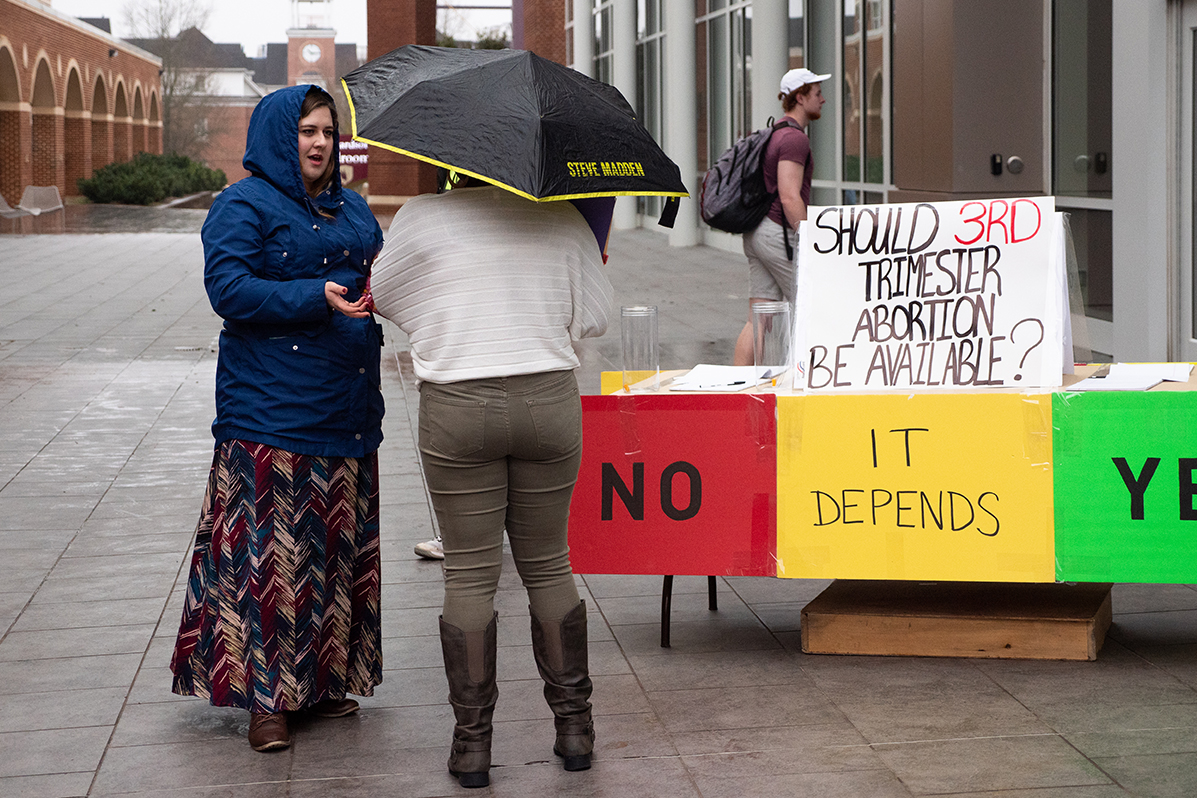
How College Students Responded to Questions About 3rd-Trimester Abortions

When I talk with people about abortion it is usually on a college campus at a free speech table that asks the broad question “Should abortion remain legal?” At my most recent visit to campus, I wanted to try something new. I asked people their thoughts specifically about the availability of third-trimester abortion.

Estimated reading time: 8 minutes.

I asked this question for two reasons. First, abortion-choice political candidates have completely abandoned the “mushy middle” pro-choice view to become abortion extremists. They want states to pass laws as New York did in 2019 to legalize abortion throughout all pregnancy until birth, for any reason. For the majority of Americans, this means that they don’t have representatives running for office that share their views on abortion. According to a 2019 Gallup poll, 53% of U.S. adults believe abortion should be legal “only under certain circumstances.” I wanted to ask people who are in the middle on this issue how they felt about the direction politicians are taking things and if that affected the way they voted. After all, that same Gallup poll showed a record high of 29% of Americans will only consider like-minded candidates on abortion.

Second, I wanted to engage with students about a significant incongruence our team has witnessed in thousands of past conversations. One of the most common pro-choice arguments is that abortion should be the woman’s legal choice because she is the only one who should have a say over what happens to her body. At the same time, most of the people we talk with who bring up this line of thinking also tell us that they think there should be restrictions put on abortion like gestational limits or circumstances like rape or if the mother’s life or health is at risk. Here is the problem: if it is true that abortion is justified because of a woman’s right to her own bodily autonomy then that must be true throughout all of the pregnancy regardless of her reasons for exercising that bodily autonomy.

You cannot make that argument for abortion during the first 8 weeks of pregnancy, but not at 24 weeks of pregnancy because later abortions give you ethical qualms. Either you must consistently apply that thinking to all of pregnancy, or use a different argument altogether to justify early abortion. You can read our full article, Bodily Rights Arguments Necessitate Extremism, for more on this point.