
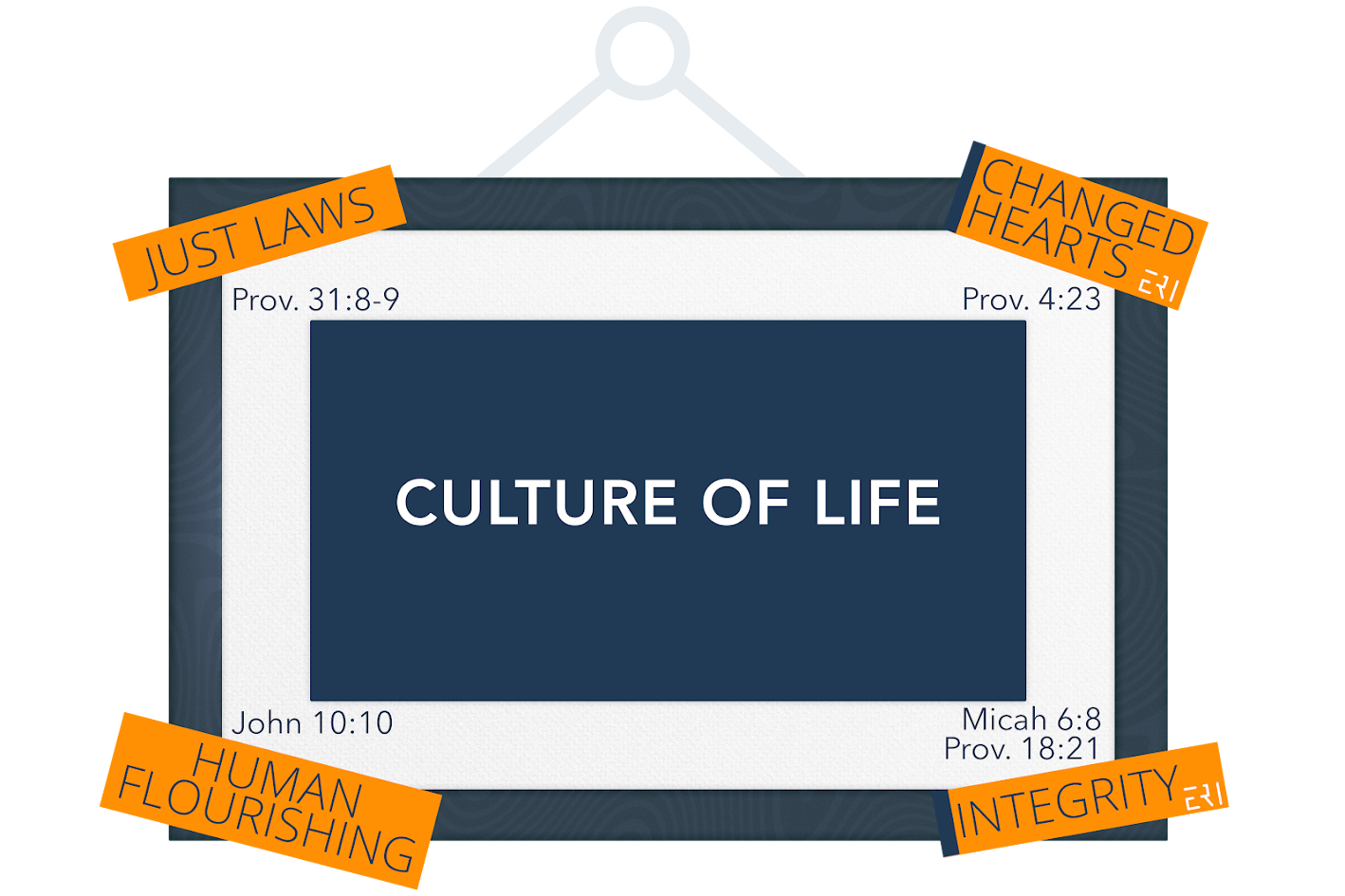
A frame has four corners. But after 50 years of ‘pro-life’ work, we’ve abandoned three corners of the frame—or, at best, let them deteriorate. Many are left clutching an important top corner, but the picture has become distorted, damaged, and is dangling in the wind. That remaining corner is important. At its best, it’s intelligently crafted pro-life policy. But there are three other corners to the frame. If we don’t reframe what it means to be pro-life in a more convictional way, our work is going to continue to be confusing, off-putting, and alienating to fresh generations. Generations that include our children and grandchildren, as well as a watching world.
That’s what I said when speaking at a church in central California recently. Let me explain what I mean.
For a lot of people, the term “pro-life” carries a lot of baggage. But I’d like you to imagine a picture that represents the best version of what a pro-life world could look like. Or, if you’d rather, replace “a pro-life world” with “a culture of life,” or “a life-affirming culture.”
Now that you have your preferred picture in mind, as well as your preferred phrase, I’d like us to think about the state of affairs in the pro-life movement using the analogy of a frame. Our most cherished pictures have frames to support and contain them. In the same way, to effectively champion a compelling vision of a culture of life, we need to support and contain that vision with a more expansive, consistent, and principled way of being pro-life. I’ll invite you to picture that way of being as a frame with four corners. Although I know not everyone reading is religious, because I’m a pastor as well as the President of ERI, in what follows, I’m going to give one or more Bible references in support of each corner of the frame. I also know that for many this will be an important way to illustrate and strengthen what I’m trying to say.
Let’s name the top-left corner of our frame Just Laws. It’s the one most closely tied to a politician’s stated beliefs (unfortunately, not always his or her true convictions). We might think of it as the legislative corner. Proverbs 31:8-9 says, “Speak up for those who cannot speak for themselves, for the rights of all who are destitute. Speak up and judge fairly; defend the rights of the poor and needy” (NIV). Just laws that protect unborn life are important, but there are also three other essential corners to the frame.
If the top-left corner of the frame is “Just Laws,” let’s call the top-right corner Changed Hearts. As many of us know well, courts and legislatures can make abortion illegal, but that’s a far cry from making it unthinkable in a particular culture. So if the first corner was the legislative corner, we’ll call this one the “unthinkable” corner.
We’ll formally announce this and say more about it soon, but I’m excited to share that ERI is updating our mission statement: “We equip everyday people to have smarter, kinder conversations that transform culture and save unborn lives.” The “transform culture” piece is directly related to the “changed hearts” or “unthinkable” corner of the frame. This corner reminds us of what internationally respected pro-life leader David Bereit said recently, and what history has shown repeatedly: “You only keep legislatively what you win upstream culturally.” Or, said differently, laws only stick when they reflect changes in the majority culture’s true thoughts and feelings.
In Bereit’s keynote, he went on to explain that “culture is not what a nation debates; culture is what a nation assumes.” For example, today we’re not having arguments about whether segregation is a human rights violation; most assume that it is. But that has not always been the case. Over time, our nation’s assumptions have changed, and our culture has been largely transformed in this area. Other examples of cultural transformation include movements like domestic violence reform, hospice and palliative care, tobacco denormalization, and civil rights. Unfortunately, when it comes to the unborn, we don’t have a broad, shared assumption that abortion is a human rights violation. That’s why it’s so important to commit more of our focus to the “unthinkable/changed hearts” corner of the frame. At ERI, we, along with many of you who partner with us, do this through developing and spreading “smarter, kinder conversations” that are laser-focused on transforming hearts and saving unborn lives. As Proverbs 4:23 says, “Guard your heart above all else, for it determines the course of your life” (NLT).
And this leads us to the bottom-right corner of the frame, which is not only essential, but also foundational in ways many have forgotten or given up on. Let’s call this the Integrity corner: by integrity, I mean both the character and the civility that go with our stated beliefs in the “legislative” corner. Or said differently, when we have integrity, our character (who we are) and civility (how we speak and act) will both be consistent with what we say and believe. In thinking about the first part of the integrity corner, character, let’s use Micah 6:8, the Bible’s simplest description of what a good human looks like: “He has shown you, O man, what is good. And what does the LORD require of you but to act justly, to love mercy, and to walk humbly with your God?” (BSB). In a person of character, justice is inseparably tied to humility and a love of mercy. For example, and to reiterate what I said to the California church, when pro-life legislation is connected to hypocrisy, corruption, and lies, this creates confusion and a disconnect in the eyes of our children and a watching world.
Civility, the second part of the integrity corner, means treating our fellow humans (including those we disagree with—even our enemies) with gentleness and respect (1 Peter 3:15). One of the most fundamental forms of respect that we can show to another person is to listen to them. Respect is very much a “life” issue, as is civility, for as the ancient wisdom in Proverbs 18:2 reminds us, “Death and life are in the power of the tongue” (KJV). Make no mistake: speech that dehumanizes anyone goes a long way to undermine the cause of humanizing and protecting precious unborn life.
The final, bottom-left corner of the frame we’ll call Human Flourishing. It encapsulates an expansive, holistic, and beautiful vision of life, capturing the sanctity of life from womb to the tomb and all the life-affirming opportunities in between. Jesus’ words in John 10:10 capture this vision well: “The thief comes only to steal and kill and destroy. I came that they may have life and have it abundantly” (ESV). Abundant Life is another way of expressing human flourishing. And this corner of the frame reminds us that pro-life work also includes consistently connecting the dots between abortion and other quality of life issues. Some traditions use the image of a “seamless garment” to capture this all-encompassing, expansive view of life from conception to natural death.
The “human flourishing” corner of the frame also offers a beautiful vision of life. English New Testament Scholar N.T. Wright notes that “beauty is both something that calls us out of ourselves and something that appeals to feelings deep within us.”1 Because of the “corner clutching” (e.g., only paying attention to the legislative/voting corner of the frame), fresh generations who care deeply about beauty are asking, “Is being pro-life an ugly form of humanity?” How will we answer them? How will we better connect the dots between abortion and other life-affirming issues? How will we reframe what it means to be pro-life in a more expansive, consistent, and principled way?
Let me close with a personal example that reminded me recently of this expansive womb-to-tomb beauty. Toward the end of 2025, I suffered a serious injury that set our family back financially because I was not able to work. As we raised a glass on New Year’s Eve, I thought to myself, “Boy, I sure hope 2026 brings some fresh hope and surprises!” Then in January, I celebrated my 60th birthday. Following this milestone, I saw the picture below where I’m surrounded by all eight of my grandchildren, and it reminded me—in the midst of all of life’s struggles—of just how rich I was. And then it hit me, related to our issue of changing hearts and minds about abortion: we need these experiences of beauty and goodness to be able to combat the ugliness of abortion without getting lost in it. We can hate and fight against abortion, but we also need to be fighting for something—both for our own sake and for the sake of casting a compelling vision for others.
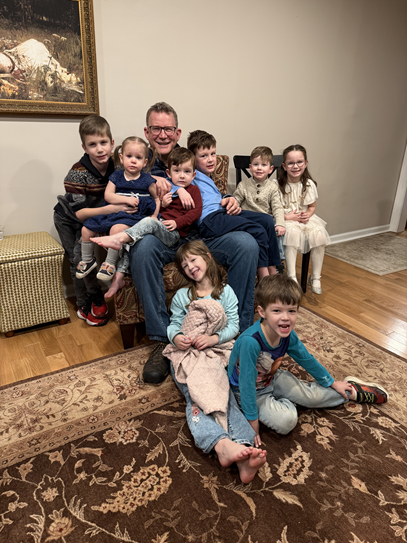
Simple glimpses like these of loving relationships and generational support are the kind of beauty that is part of human flourishing and a reframed culture of life—the kind we need to recapture, celebrate, and cherish for ourselves, our children, and our communities as part of what it means to be pro-life.
So we ask you to pray, continue to partner, and send us feedback as we “equip everyday people to have smarter, kinder conversations that transform culture and save unborn lives”—and as we champion reframing the life issue for a new day.
Yes, attending to and clutching only one corner of the frame is easier. But we know the results well: short-term wins and fragile legislation that can be changed with one stroke of the pen.
This kind of “corner clutching” is a form of doing the same thing over and over and expecting a different result—which is Einstein’s definition of insanity. We can recommit, however, to reframing what it means to be pro-life in a more principled way—attending to all four corners: just laws, changed hearts, integrity, and human flourishing. Admittedly, it’s a much harder path and a long-term investment, but it’s one that promises a much clearer picture of all that it means to be pro-life and a compelling vision that celebrates all that is good, beautiful, real, and true.
Will you join us? If so, subscribe here, and if you have already, please consider sharing this article with a friend.
- N.T. Wright, Simply Christian (New York:Harper Collins, 2006), 44. ↩︎
